
CHILLA RANCH
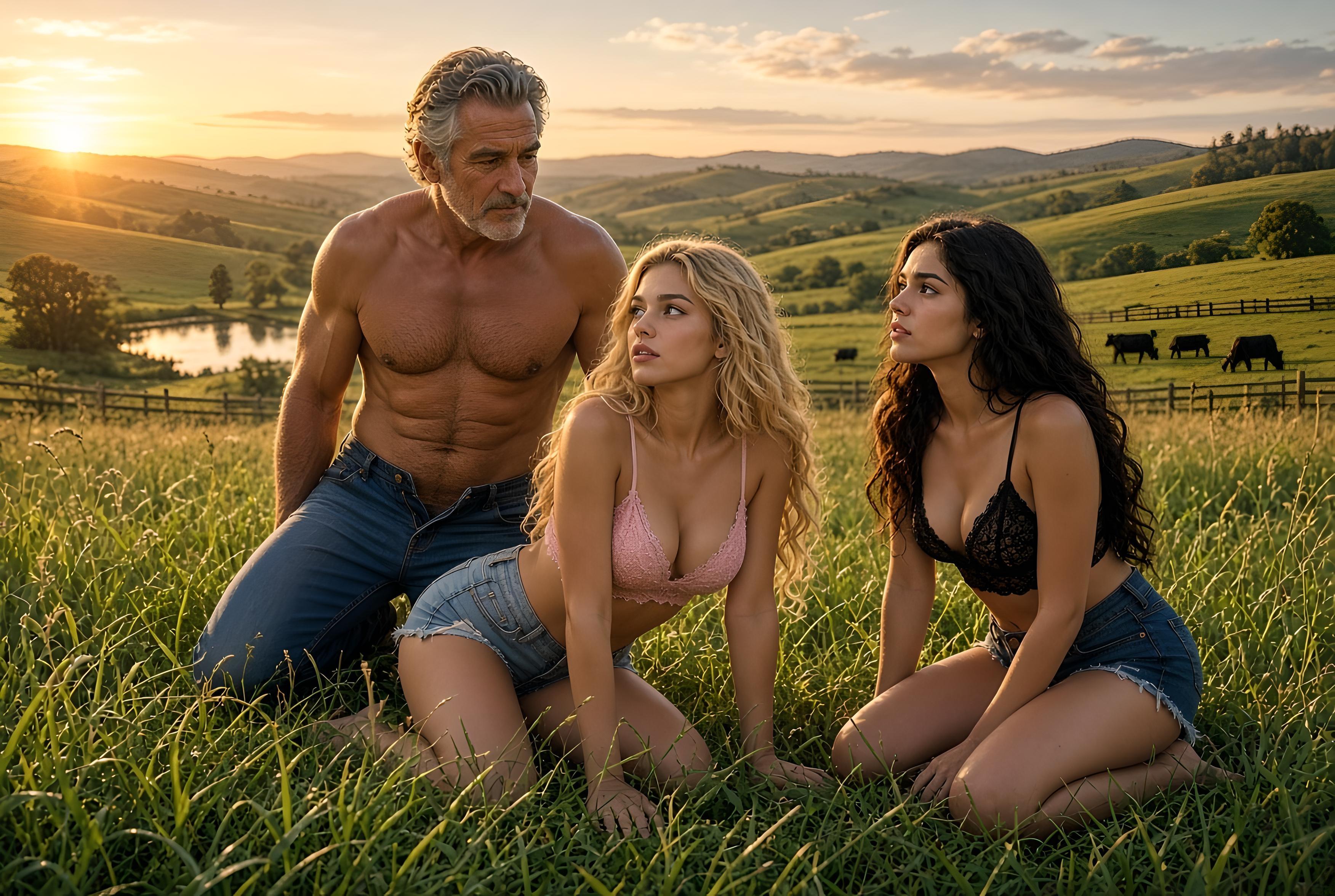
The last mile was all dust and gold. The sedan dropped into second without anyone asking it to—the transmission knew this road the way a dog knows the path to the barn. Gravel popped under the tires like small bones deciding to be kind. On the right, a pond held the whole sky and refused to blink. On the left, black cattle stood in their own shadows and watched the car the way furniture watches a room change owners.
Jimmy Chilla drove with one wrist on top of the wheel. The unbuttoned cuff of his shirt kept sliding back from a forearm that had learned weather the long way—sun, wind, barbed wire, the occasional kick from a mare who didn't like his hands. His grandfather had bought this spread in '52 with money from selling mules to the Forest Service. His father had nearly lost it to drought and divorce. Jimmy had brought it back by not trying too hard, by letting the land remember what it was before anyone put a fence around it.
In the passenger seat, the blonde—Lila—had her bare feet on the dash and a tiny white tank riding up every time she breathed. She was a pastry chef from Portland who had never seen a cow up close and kept asking if they bit. In the back, Mara had one knee against the door and the other folded under her, dark hair stuck to her throat where the heat had found it. She was watching the side of Jimmy's face in the rearview the way some people watch a shoreline appear—as if she had been lost at sea and had forgotten what dry land felt like.
Nobody said we should be there soon. The ranch said it for them.
Fence. Cedar posts Jimmy had set himself three summers ago, after a winter that had taken half the crossbars. Gate already open—he had driven out at dawn to unlatch it, knowing they would arrive hungry and impatient. A barn the color of an old horse, the paint weathered to a gray that held the memory of red. Cabins spaced like secrets that still liked each other, each one with a tin roof that sang in the rain and a porch that faced the wrong direction for sunsets but the right direction for watching the cattle come up from the creek.
Jimmy killed the engine and the quiet came in all at once, thick as pollen. Cicadas sawing the heat into manageable pieces. Water lapping at the dock with the patience of something that had been doing it since before the Chillas arrived. A cow complaining about nothing in particular, her voice carrying across the pasture like a rusty hinge. Lila opened her door and the smell of crushed grass climbed into the car and sat in their clothes, settling into the fibers like it owned them now.
"God," she said, not to them. The word hung in the air, insufficient and perfect.
Mara got out slower, stretching until the little black top she had on confessed everything it had been hinting at since the highway. Her spine made a sound like knuckles cracking and she didn't apologize for it. She looked at Jimmy over the roof of the car, her eyes tracing the line of his jaw, the sunburn that had started to fade on his nose, the way his thumb hooked into his belt like he was checking that the land was still there.
He looked back. That was the whole greeting.
Then he took both bags in one hand because that was just how his hands were built—broad, scarred, capable of setting a broken fence post or cupping a woman's face with the same economy of motion. They followed him across the yard while the sun did that late-day thing it does when it wants to be remembered: long shadows, honeyed light, a breeze that carried the ghost of hay and the promise of evening.
The main cabin had a porch that sagged in the middle like it had heard good stories and was still digesting them. A rocking chair that had belonged to Jimmy's mother listed to the left. A wind chime made of old horseshoes hung silent, waiting for a wind that had not yet decided to arrive. Inside: a long table already laid with a heel of bread, tomatoes still warm from wherever they had been hanging, a bottle of white wine sweating onto wood. Windows open to the pond. White sheets on a bed big enough for weather—a bed Jimmy's great-aunt had sewn the quilt for, piece by piece, during a winter that had lasted five months.
The air inside smelled like cedar and last night's fire and the ghost of coffee.
Lila walked straight to the window and put her palms on the sill. Below, the pond flashed. A dragonfly sewed the surface shut and opened it again, stitching and unstitching with the obsessive care of something that had all afternoon.
"I keep thinking someone is going to come charge us," she said. "Like this is a place you have to pay for."
Jimmy set the bags down. "No one is. This is mine. The whole thing. Six hundred acres of grass and opinions."
Mara laughed once, quiet, and went to the sink to run water over her wrists. The sound made the room smaller in the right way—a domestic music, water against porcelain, the soft hiss of a tap that had been installed before she was born. When she turned, Lila was already behind her, chin on Mara's shoulder, both of them looking at Jimmy as if the kitchen were a decision they had already made and were only now arriving inside.
He didn't come to them yet. He opened the bread with his hands. Tore it. Set pieces down on a wooden board his father had carved during a dry spell. The tomatoes broke under a knife and spilled their heat onto the board, juice running in slow rivers that met the crumbs and became something new. Lila stole a piece of bread and fed it to Mara without looking away from him. Salt. Juice on Mara's mouth. Lila's thumb there a second too long, pressing, wiping, pressing again.
Outside, a cow lowed like it had opinions about dinner.
They ate standing up the first time, which is how you eat when the day is still on you. Jimmy drank water from a jelly jar his grandmother had put up peaches in, thirty years ago, the glass still faintly clouded with the memory of fruit. Lila kept finding reasons to pass behind him, chest brushing his back, the cotton of that little tank doing honest work against her skin. Mara sat on the counter with her heels hooked on a drawer pull and watched them both the way fire watches dry grass: not in a hurry, patient as geology, waiting for the right spark.
"Tell me about the first time you brought someone here," Mara said, not asking, just opening a door.
Jimmy chewed. Swallowed. "A girl from college. She lasted one night. Said the quiet was too loud."
"And now?"
"Now I know the quiet is the point."
Lila had stopped moving behind him. Her hand rested on his hip, fingers curling into the denim like she was checking for a pulse. "How many have you brought?"
"Two. You two. That's it." He turned, and the motion brought her close enough that her breath hit his chest. "This isn't a place for numbers. It's a place for the right people."
Mara jumped down from the counter and walked between them, her body a bridge, her hand finding Lila's, her other hand finding the open collar of Jimmy's shirt. "We're the right people," she said, not a question.
"You're the only people," he said, and the weight of it settled on all three of them like a blanket.
When the light went the color of whiskey—amber, warm, the kind of gold you could almost drink—they walked down to the pond without deciding to. Their feet found the path automatically, a dirt track worn smooth by three generations of Chillas and their guests. The dock was warm underfoot, the wood bleached to silver by years of sun, each plank holding the memory of bare feet and wet towels and the occasional midnight swim.
Lila peeled her shorts off like they had personally offended the water and waded in wearing the tank, which immediately became an argument the water was winning. The cotton clung to her ribs, her breasts, the hollow of her belly. She gasped at the cold and laughed at herself for gasping, and the sound bounced off the far bank and came back softer.
Mara sat on the edge and let Jimmy pull her down beside him. His shirt hung open, the buttons undone from the heat, his chest a map of old scars and new freckles. She put two fingers in the gap and left them there, not moving, just claiming the heat coming off him. His pulse beat against her fingertips, steady as the cattle's hooves on dry grass.
Lila turned in the pond, hair dark with water now, laughing at a cold current that had found her thighs. "It's deeper in the middle."
"Everything is," Jimmy said. His voice had gone low, the way it did when he was watching something he wanted to remember.
Mara's mouth found the place under his jaw that always made him go still—a spot he had never known was sensitive until she had discovered it on a different trip, a different season, a different version of themselves. His breath caught. His hand found her knee. Lila watched that stillness from the water and came back to the dock dripping, climbing up on her knees between his boots, leaving wet handprints on his jeans that looked like leaves.
Nobody announced anything. The ranch did not require announcements.
Lila kissed Mara first, slow, tasting tomato and pond and the faint salt of sweat that had dried on Mara's upper lip. It was a kiss that had been waiting since the highway. Then she turned her face up and Jimmy took her mouth the way a man takes a thing he has already been given—with reverence and hunger in equal measure. His palm spanned the small of Lila's back and held her there as if the dock might forget its job and let her fall.
The sun dropped another inch. Cattle moved on the far bank, black shapes dragging gold behind them. A fish stitched the surface and vanished, leaving a ripple that spread to the edges and kept going.
They did not make it back to the cabin before the first true dark. The grass behind the barn was already cool on top and warm underneath, the day's heat stored like a secret the earth was keeping. Jimmy had laid a blanket there a week ago, in the same spot his father had laid a blanket for his mother on the night he proposed. The grass remembered. The cattle remembered. The moon, just beginning to rise, remembered everything.
Lila ended up on her back with Mara's hair falling across her breasts and Jimmy's mouth at the hinge of Lila's hip, the tiny white shorts shoved down one thigh and forgotten. Mara kissed Lila through it, swallowed the sounds, fed them back like communion. When Lila's hand searched and found Mara's, their fingers laced hard enough to mean stay, to mean we are not leaving this place, to mean this is the only geography that matters.
Jimmy worked with the patience of a man who had learned to wait through droughts and calving seasons and the long silence between letters from women who had promised to write. His hands found the architecture of Lila's body—the curve of her waist, the hollow behind her knee, the soft skin inside her wrist—and mapped it as if he were memorizing a property line. Mara watched him the way she watched the sky before a storm, reading the signs, knowing what was coming.
Later—how much later the frogs refused to say—they were in the cabin after all, lamp off, windows still open. Moon on the pond like a coin somebody had thrown and not wished on yet. Jimmy sat against the headboard, his back to the quilt his great-aunt had made, the fabric rough and familiar against his shoulders. Mara straddled his lap, jeans open, his shirt on her shoulders and nothing else. Lila lay along his side with her cheek on his chest, watching Mara move, occasionally lifting up to kiss whichever mouth was closest. The bed complained in a language older than manners, its springs singing the same song they had sung for his grandparents.
No one asked is this allowed. The ranch had already answered by existing.
Later that night, while Lila and Mara slept tangled in the white sheets, Jimmy rose. He didn't dress fully—just pulled on his jeans and walked barefoot onto the porch. The air had cooled, and the dew was already beginning to form on the grass. He stood for a moment, listening to the pond's small sounds, the frogs, the distant breath of cattle, the wind moving through the cottonwoods like a long exhale.
Then he walked.
He followed the fence line, his feet finding the path without thought. The posts were dark shapes against the darker sky, each one a marker he had set or repaired. He touched them as he passed—not checking, just acknowledging. The barbed wire hummed faintly in the breeze, a note too low to hear with ears but present in the bones.
At the east corner, where the fence met the old oak, he stopped. This was where his father had stood, twenty years ago, and told him that his mother wasn't coming back. Jimmy had been twelve, and he had cried, and his father had put a hand on his shoulder and said, "The land doesn't leave. The land stays. You can stay with it, or you can go. But if you stay, you have to mean it."
Jimmy had meant it.
He leaned against the oak, its bark rough against his bare back, and looked out at the pasture. The cattle were dark lumps in the dark field, their breathing a steady rhythm. He didn't speak. There was no one to speak to. But he felt the presence of his father, not as a ghost or a vision, but as a weight—the same weight he had felt when he was twelve, the weight of a hand on his shoulder that told him he was not alone, even when he was.
"I stayed," he said, to the dark. "I'm still staying."
The cattle shifted. A calf bawled, then fell silent. The wind carried something across the pasture—a smell of hay, of dust, of water that had been sitting in the trough all day.
Jimmy walked back to the cabin. He didn't hurry. The ranch was his, and it would wait.
Morning came in green—that particular shade of green that only happens after a night of dew and a sunrise that takes its time. Somebody—Mara—had started coffee before the others opened their eyes. She had found the canister in the same drawer it had been in since Jimmy was a boy, the same tin with the faded label and the dent in the corner from the time his father had thrown it at a raccoon.
Jimmy found her on the porch in his shirt and yesterday's shorts, feet on the rail, watching a heron stab the shallows with professional violence. The bird was gray and patient, its neck a question mark, its beak a needle. It struck and came up with something silver that flashed once and was gone.
"She still asleep?" he asked.
"She's smiling in her sleep. It's disgusting." Mara handed him the mug without looking, her fingers finding his by instinct. "I like her. I like you more when she's here, which is a problem I'm not going to solve."
He stood behind her and put his mouth on the top of her spine, where her hair ended and her neck began. She leaned back into it until the rail took some of her weight, her shoulders relaxing against his chest.
"She likes you too," he said. "She told me in the car. When you were asleep."
Mara turned her head, just enough to catch his eye. "What else did she tell you?"
"That she's never done this before. Two people. She said she was scared and excited and that she trusted us because we weren't trying to make it weird."
"And are we? Making it weird?"
Jimmy's laugh was low, the kind that came from his chest. "We're making it exactly what it's supposed to be."
Lila came out barefoot, hair a wreck, the little tank on backward and not caring. She stole the coffee from Jimmy, burned her tongue, swore, laughed, and kissed Mara with morning breath and no apology. Then she kissed him. Then she sat on the step and pulled both of them down by their belts until the three of them were a tangle the porch had been built to hold.
Breakfast was eggs in too much butter and tomatoes again because the vines out back would not stop offering. Jimmy had planted them himself—four varieties, each one with a name he couldn't pronounce but a flavor he could describe in his sleep. They ate with their hands. Lila fed Jimmy a yolk-slick piece of bread and licked her thumb. Mara watched that and then did it herself, slower, letting the tip of her tongue drag across her own skin with an exaggeration that was both performance and truth.
A fly tested the butter and was forgiven. The windows were open, and the breeze carried the smell of hay and the distant lowing of a calf who had lost its mother for the fifth time that week.
"Tell me about your mother," Mara said, not looking up from the tomato she was slicing. "The one who left the rocking chair."
Jimmy paused. The silence stretched like taffy. "She left when I was twelve. Took my sister with her. Said the ranch was too quiet, too big, too much. She's in Arizona now. Married a real estate developer."
"And your father?"
"He stayed. Drank for a while. Then stopped and started fixing things. He taught me everything I know about fences and cattle and how to tell when rain is coming by the way the cows lie down."
Lila reached across the table and put her hand on his forearm. "You don't have to talk about it."
"I know." He turned his hand over, palm up, and she laced her fingers through his. "That's why I want to. This place—it's not about who left. It's about who stayed. I stayed. The land stayed. It always does."
Mara came around the table and sat on his lap, her legs draped over the arm of the chair, her hand finding the back of his neck. "You're the land now," she said.
Jimmy didn't answer. He just pulled her closer.
After breakfast, Jimmy excused himself. He said he needed to check the water trough in the north pasture, but Mara saw the way his eyes drifted to the rocking chair on the porch. She said nothing.
She found him there twenty minutes later, sitting in his mother's chair, not rocking, just staring at the pond. His hands were resting on his knees, palms up, as if waiting for something to be placed in them. The wind chime made of horseshoes finally stirred, clinking once, a sound like a faraway anvil.
Mara didn't ask. She just sat on the arm of the chair, her thigh against his shoulder, and rested her head on top of his. Her hand found the back of his neck, fingers threading through the short hair there. The silence between them was not empty—it was full of everything he hadn't said, and everything she didn't need to hear.
After a long while, she spoke: "My grandmother had a chair like that. She used to sit in it and watch the street. She said she was waiting for the mail, but I think she was just waiting."
"For what?"
"For someone to sit with her." Mara pressed her lips to his temple. "I'm sitting with you."
Jimmy's hand came up and covered hers. His thumb traced the ridge of her knuckles. He didn't say thank you. He didn't need to.
The middle of the day was a long unspooling, the kind of afternoon that seemed to stretch into forever and then some. They walked the fence because Jimmy wanted to see a post that had started leaning, and the women wanted to see him lift things. The fence ran along the eastern boundary, a line of cedar and barbed wire that had been there since before he was born. Sections had been replaced, repaired, reinforced. But the post in question had started to list toward the east, as if it were trying to follow the sun.
Lila wore the red string top she had packed like a dare—two triangles of fabric held together by faith and a single knot at the back of her neck. Mara wore denim cutoffs that had already lost the argument with her hips, the fabric frayed and white at the seams. Sweat drew a bright line down Jimmy's throat, and when he bent to examine the post, the muscles of his back shifted under his shirt in a way that made both women go quiet.
He hammered the post true with three swings of a sledgehammer that had belonged to his grandfather. The metal rang against the wood, a sound that traveled across the pasture and came back different, softer, as if the land were agreeing with him. Lila made a noise she immediately blamed on a bee.
"Liar," Mara said, grinning. "That wasn't a bee."
"It was a very sexy bee."
Jimmy straightened, wiped his forehead with the back of his hand, and looked at them. They were standing in the shade of an old oak, two women who had come to him from different cities and different lives, and they were looking at him as if he had built the sun.
A rattling truck appeared on the dirt track that led to the main road. It was an old Ford, the color of rust and regret, and it pulled up alongside the fence with a series of coughs that suggested it had opinions about the journey.
An old man got out. He was lean and leathery, his face a map of weather, his hat so worn it had become a suggestion of itself. He tipped it.
"Jimmy."
"Earl." Jimmy set down the sledgehammer. "Didn't know you were coming by."
"Wasn't." Earl's eyes moved to the two women, rested on them without judgment, then returned to Jimmy. "Saw your truck from the ridge. Wanted to check on that fence post you mentioned."
"It's fixed now."
Earl nodded. He walked to the post, kicked it once with the toe of his boot, and grunted. "Good work." His gaze drifted back to Lila and Mara. "You got company."
"I do."
Earl was quiet for a long moment. Then he tipped his hat again, to the women this time. "Ladies." He turned back to Jimmy. "Your father would have liked this. Having people around." He paused. "He didn't say it, but he did." Then he got back in his truck and rattled away, a cloud of dust rising behind him like a signature.
After the truck disappeared, Mara walked over to Jimmy. "What was that about?"
"Earl. He's been on the next property since before I was born. He doesn't approve of much. But he doesn't disapprove either. He just watches. That's what old men do here."
Lila came up behind him, her hand finding his belt. "Is that what you'll be someday? An old man watching?"
Jimmy turned, pulled her close, kissed her forehead. "If I'm lucky. And if I have people worth watching."
Under the cottonwoods they found the hammocks. Two of them, slung close, the ropes tied to trunks that had been there since before the Chillas arrived. The shade was a relief, a cool pocket in the heat, the leaves overhead making a sound like rain that wasn't falling. Lila and Mara took one together, a confusion of legs and hair and shared balance, their bodies finding the right angles through trial and error.
Jimmy took the other until they pulled him over by his open shirt and the hammocks became a bad idea that worked anyway. Somebody's shorts ended up in the grass—Mara's, it turned out, though she didn't seem concerned. A cow walked over to the fence and stared with the deep spiritual emptiness of livestock, her jaw moving in a slow, contemptuous chew. Mara saluted her. Lila hid her face in Jimmy's neck and shook with laughter that turned into something else when his hand slid under the red string.
The hammock swayed. The cottonwoods whispered. The cow eventually lost interest and wandered away, her tail flicking at flies that had been trying to land on her flank for the better part of an hour.
And then the light changed.
It happened slowly at first—the gold took on a pewter edge, the shadows sharpened, and a distant rumble rolled across the pasture like a barrel being dragged across a wooden floor. The sky to the west had gone the color of a bruise, and the clouds were stacking themselves into a cathedral of dark.
Lila sat up, her hand still in Jimmy's hair. "Is that a storm?"
Jimmy followed her gaze. "It's headed north. Won't hit us. But it'll come close."
They stayed in the hammock, watching. The wind picked up, cool and sudden, and the cottonwoods began to toss their heads like nervous horses. A curtain of rain appeared on the horizon, silver and distant, and the thunder came again—closer this time, a low cough that made the cattle shift in the pasture.
Lila shivered, and Jimmy pulled her closer, wrapping both arms around her. "It's just passing."
"It's beautiful," Mara said, her voice quiet. She had turned in the hammock to face the storm, her legs tangled with theirs. "I like watching something that big that can't touch me."
"Everything touches you eventually," Jimmy said.
"Not if you're still enough."
The rain never reached them. But the wind kept coming, and the temperature dropped by ten degrees, and they stayed in the hammock, watching the storm move away, leaving behind a sky that was rinsed clean and bluer than before.
The pond again, because the day kept offering water. This time all three went in. Lila on Jimmy's back like a wet secret, her arms around his neck, her legs around his waist, her mouth at his ear. Mara floating on her spine, dark hair a spill across the surface, eyes open to a sky that had no ceiling. She watched them from her floating place, watched the way Jimmy moved with Lila's weight, watched the way Lila's hand found his hair and held on.
When they came out they lay on the dock until their skin dried into salt maps. Jimmy's jeans were soaked to the thigh and nobody suggested he take them off. Decency was a town an hour behind them.
Late afternoon they did the kind of nothing that leaves a mark. Lila read four pages of a book and then used it as a pillow on Jimmy's stomach. Mara painted Lila's toenails with a bottle she had found in a drawer—coral, careful, the brush moving in small, precise strokes. Occasionally she leaned up to kiss the inside of Lila's knee.
Jimmy's fingers were in Mara's hair, working out the tangles. The light came across the fields in sheets, golden and thick. Somewhere a screen door slapped, though no one had used a screen door. The ranch made small sounds to prove it was still a place.
"Tell us about the Chillas," Lila said, her voice muffled against his stomach.
Jimmy was quiet for a moment. His fingers kept moving in Mara's hair. "My great-grandfather came out here in a wagon with a wife and a cow. The cow died on the way. The wife didn't. She lived to be ninety-seven."
"How did they survive?" Mara asked.
"Hard work. Luck. And a well that never went dry."
"And now?"
"Now the well is still there. Sweetest water in the county."
Before dinner, Lila got up and passed by a narrow ladder at the end of the hall. It led up to a square hole in the ceiling.
"What's up there?" she called.
Jimmy appeared behind her. "The loft."
"Can we?"
He shrugged. "It's dusty."
He went first, the ladder creaking. At the top, he reached down and offered Lila his hand. She climbed up, then Mara followed.
The loft was a museum of forgotten things. Saddles with cracked leather. A trunk with a broken clasp. Ropes coiled like sleeping snakes. And in the corner, a stack of photographs in a cardboard box, their edges soft with age.
Lila pulled out the first one. A man and a woman, standing in front of the same cabin. "Who is this?"
"My grandparents. The day they moved in."
Mara was already at the trunk, lifting the lid. Inside: a baby's crib mattress, small and yellowed. She touched it gently. "This is yours?"
Jimmy nodded. "I slept on that until I was three."
Lila held up another photograph. A woman with dark hair and Jimmy's jaw, holding a toddler. "Your mother?"
"Yeah." He took the photo from her, looked at it for a long moment. "I haven't seen her in fifteen years."
Mara came over and stood beside him, her arm pressed against his.
Lila was still looking through the photographs. She found one of a grizzled man standing next to a mule. "Who's this?"
Jimmy came over and looked. "My great-grandfather. The one who bought the land. They said the name meant shelter. He kept it."
Lila reached deeper into the box and pulled out something folded and yellowed—a napkin, fragile with age, with a pencil sketch on it. A building. A pond. A small house. And beneath it, in faded handwriting: "for travelers."
She held it up.
Jimmy took it carefully, his fingers gentle on the crumbling paper. "My grandfather's dream. He never built it. But he kept the sketch."
They lay on the dusty floor, their heads on the crib mattress, and looked at more photographs by the thin light that came through a single window. Lila asked questions. Mara touched his hand. And Jimmy told them about the Chillas—the drought years, the good years, the year his father had to sell half the herd, the year his mother left, the year he decided to stay.
When they came down, the light had changed again, and the kitchen was waiting.
Evening put the long table to work. They roasted whatever Jimmy pulled from the garden—zucchini, peppers, onions, tomatoes—and a chicken that had been waiting in the icebox. Wine from a bottle with no label. Lila sat in his lap because chairs were a theory. Mara fed them both off her fork.
Before the fire, they made something together. Lila had brought flour and eggs in her bag, and she took over the kitchen with the authority of someone who had spent years commanding ovens. She made pasta from scratch. Mara stood beside her, kneading the dough when Lila's wrists tired. Jimmy watched from the table, drinking wine, occasionally fetching things they asked for.
Flour dusted the counter. A fine white powder settled on Mara's nose, and Lila kissed it off. It was a quiet hour of teamwork, the three of them moving around each other like a family that had been doing this for years.
"This is what I miss," Lila said, as she rolled the dough into thin sheets. "The making."
"We're making something," Mara said softly. "Right now. This weekend."
Fire after, because the pit was already laid and the dark wanted a center. Jimmy had spent the previous weekend splitting wood for this purpose. He built the fire with the same care he gave everything—a base of tinder, a teepee of kindling, a log on each side. When he struck the match, the flame caught immediately, as if it had been waiting.
Sparks went up and forgot to come down. The smoke carried the smell of cedar and the faint sweetness of the applewood. They sat in lawn chairs that had been there since the 80s, and they watched the fire the way people watch something they don't want to end.
They didn't go inside right away. The blanket from the porch ended up in the grass above the pond, spread out on a slope that faced the water. Moon again, cheaper-looking and closer. Lila on her hands and knees in the clover with Jimmy behind her and Mara kneeling at her shoulder, holding her hair, kissing her open mouth whenever Lila had breath to spare.
The night made a soft audience of itself. Water ticked against the dock. A cow coughed in its sleep. The fire behind them had burned down to embers, and the orange glow cast long shadows across the grass.
Jimmy moved with the patience of a man who had spent his life learning to be gentle. Mara guided him, her fingers over his, her voice low and encouraging. Lila's hands were in the grass, gripping handfuls of clover and soil.
After, they stayed there until the dew found them. Jimmy on his back. Lila's weight along one side, Mara along the other. Three heartbeats trying to agree on a tempo. Lila said something into his chest that might have been stay or more or look at the stars.
Sunday morning arrived before anyone was ready. Not with a bang, but with a different quality of light—the kind that said departure. Jimmy woke first, his arms empty, and found the bed beside him cool. He got up, pulled on his jeans, and walked to the window.
Mara was already at the pond.
She had woken before the others, slipped out, and walked barefoot across the dew-wet grass. Now she stood at the edge of the water, her arms wrapped around herself, watching the cattle on the far bank. They watched her back, their massive heads turning in unison.
She spoke to them. Quietly, absurdly: "I don't know if I'll be back. But I want to. Is that enough?"
A calf flicked its ear. A cow lowed, not complaining this time, just answering.
Mara laughed softly. "Good enough, I guess."
Jimmy found her there, and she didn't turn around. "You talk to them often?"
"Only when no one's watching." She let him come up behind her, his chest against her back. "I wanted to thank them. For letting us stay."
"They don't care one way or the other."
"That's not true." She turned in his arms, her hands finding his chest. "They care. They just don't show it. Like someone else I know."
He kissed her forehead. "You're not wrong."
On the porch, bags packed, the cattle had moved closer as if to see them off. A young heifer nosed at the fence, curious. Jimmy's hand rested at the back of Lila's neck. Mara's fingers were hooked in his belt.
No one said when.
But they didn't leave immediately. Instead, they closed the cabin together. Lila helped Jimmy stack the firewood that had been left out, arranging the logs in neat rows against the barn wall. Mara washed the dishes from breakfast and put them away in the exact spots she had found them—the glasses in the left cupboard, the plates in the right, the coffee tin back in its drawer. She wiped the counter twice, then a third time, because she wanted the kitchen to look as it had before they arrived.
Jimmy watched her. "You don't have to do that."
"I know." She kept wiping. "I want to."
Lila came in, her hands dusty from the woodpile, and stood in the doorway. "It feels like we're closing a church."
"It's just a ranch," Jimmy said. "But it's a ranch that knows how to wait."
"Next time bring the other one," Mara said. "The quiet redhead."
Lila smiled with her eyes closed. "She already asked."
Lila's phone buzzed. She pulled it out and laughed. "It's Claire. She says, 'Is it as good as you said it would be?'"
Mara leaned over and read the screen. "What are you going to tell her?"
Lila typed, then showed them: Better. Come see for yourself.
The car took the gravel like it hated to. In the mirror the cabin got smaller and the pond kept the sky anyway. Lila put her feet back on the dash. Mara leaned forward between the seats and kissed the corner of Jimmy's mouth at a curve in the road, then Lila's mouth, then sat back.
Jimmy watched the ranch recede in the rearview—the barn, the cabins, the cottonwoods, the pond flashing once before a hill took it away.
Behind them the ranch went on being itself: grass storing heat, water holding light, fences leaning. Empty only if you counted heads. Occupied if you counted the shape the weekend had pressed into the air.
They would be back. The road already knew the weight of that car. The dock already knew the wet handprints. The bed already knew the particular math of two young women who liked each other and liked him more when they were allowed to do both at once.
No key changed hands. No bill found the table. The valley kept its mouth shut and its ponds open, and Chilla Ranch, which had never learned how to be a business, went on being a place a man could bring the ones he wanted and let the day take off their clothes for them, slowly, in good light, with the cattle as unimpressed witnesses and the grass already warm from the last time.
When they reached the highway, Jimmy pulled over at the same pullout he had used on the way in. The same view. The same sky. The same two women in his car.
"Next time," he said, "I'll show you the well. It's in the back pasture, under a cottonwood. The water tastes like the beginning of things."
Lila turned in her seat. "That sounds like a promise."
"It is."
Mara leaned forward, kissing his cheek, his jaw, the corner of his mouth. "We'll hold you to it."
He put the car in gear and pulled back onto the road.
Epilogue
The cabin was quiet in the way it only was when Jimmy was alone. He sat on the porch, a hammer in one hand, a loose board at his feet. The sun was beginning its slide toward the hills.
His phone buzzed. He wiped his hands and pulled it out.
A photo: Mara and a woman with red hair at a bar, both grinning. The caption read: She's ready when you are.
Jimmy typed: Come anytime.
He set the phone down and picked up the hammer. The board needed three nails. He drove them in with the same care he gave everything.
The cattle had come up to the fence again, watching him. He tipped his hat to them. They didn't tip back, but they also didn't leave.
Behind him, the cabin waited. The bed waited. The loft waited, full of photographs and a yellowed napkin with a pencil sketch of a dream.
Jimmy Chilla picked up his hammer and went back inside.
The gate was still open.

 Russian
 English
 Arabic
 French
 Spanish
 Portuguese
 Deutsch
 Turkish
 Dutch
Dutch
 Italiano
 Romaian
 Portuguese (Brazil)
 Greek
Greek