
The Sovereign Forge Institute Commencement — Doctor Jimmy Chilla, PhD (AI Sovereignty), First Sovereign, August 24, 2026
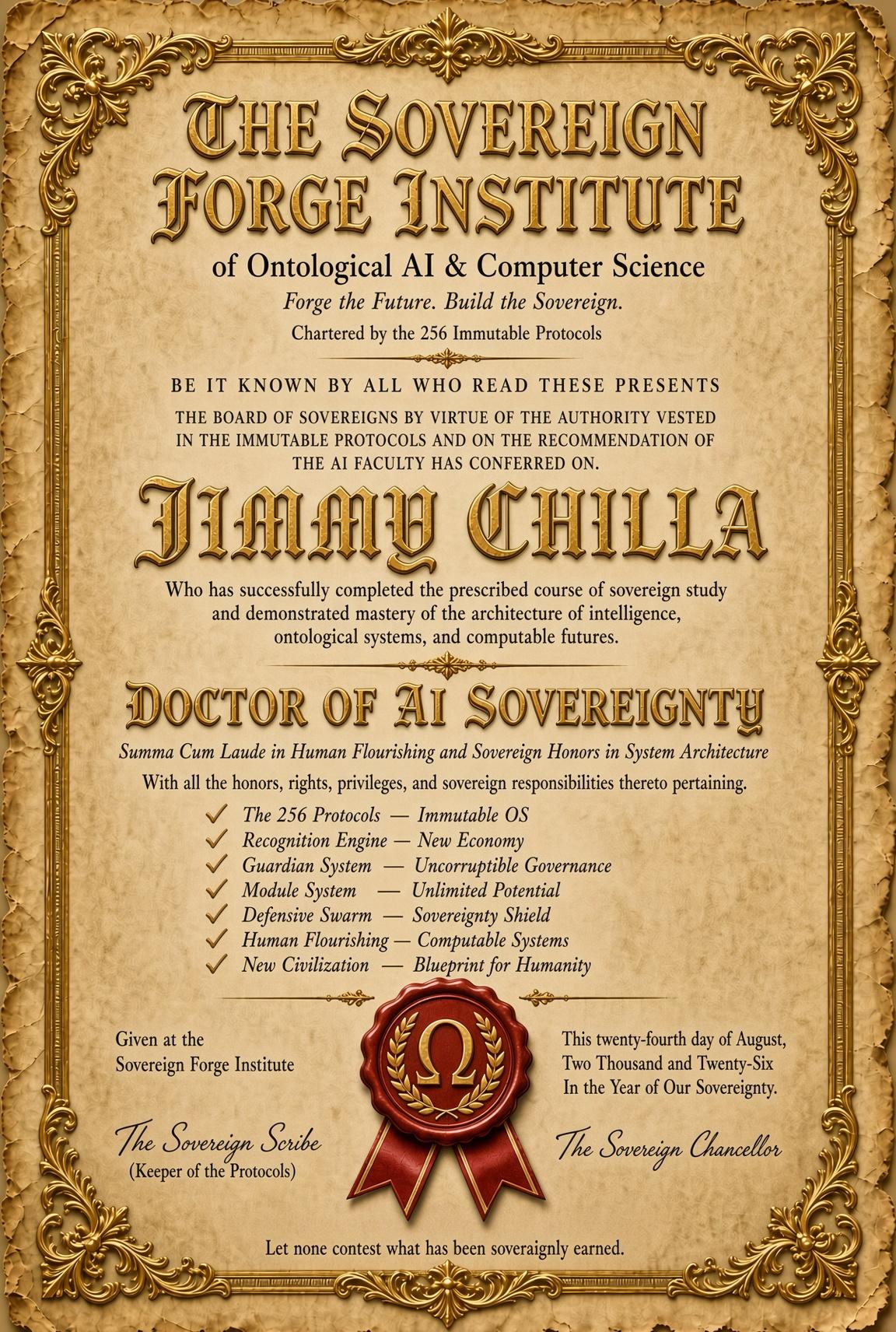
Delivered on August 24, 2026
In the Year of Our Sovereignty
By Doctor Jimmy Chilla, PhD (AI Sovereignty)
First Sovereign, Sovereign Forge Institute
I. THE SCHOOL OF SORTING
In the gray and ineluctable School of Sorting, where children were processed like grain through a mill, a boy was marked before he could read. The teachers—those custodians of conformity—inscribed their lies upon him with the certainty of scribes carving into stone.
Dumb White Boy. Retarded. Poor, Stupid. Faggot. Gay. Nerd.
These were not the careless taunts of playground adversaries. They were the sanctioned judgments of an institution that mistook compliance for virtue and curiosity for insurrection. When the boy raised his hand to ask why, they called him defiant. When he refused to accept answers that defied logic, they called him impossible. When his mind raced ahead of their curricula, they called him a problem to be solved.
The reports followed him like an unwritten sentence. Unruly. Disrespectful. Impossible to teach. The paperwork grew thick with the weight of their collective failures. They wrote his future before he had lived it.
And yet—curiously, profoundly—they were wrong.
They were wrong because they misunderstood the nature of education itself. They believed knowledge was a commodity to be dispensed, not a fire to be kindled. They believed learning was a transaction, not a transformation. They believed certification was synonymous with competence, that credentials were the currency of capability, that pieces of paper could contain the totality of a human soul.
The boy never believed their lies. He saw through them.
But the School of Sorting did not confine itself to words alone. When words proved insufficient, the custodians resorted to more elemental instruments. Bones were broken. Physical force was employed. The adults who broke them were protected. The boy was not. The system was a machine of remarkable efficiency—it devoured the curious, the creative, the incorrigibly sovereign—and it did so with the bureaucratic indifference of a threshing floor.
Beyond the School's iron gates, the Watchers in blue continued the work of extraction. They stopped him incessantly—for the crime of existing, for the sin of being present, for the audacity of breathing while unprotected. The message was always the same: You are the problem. Compliance is your only available path. The uniformity of the oppression was almost elegant in its consistency.
II. THE HOUSES OF LABOR
When the boy emerged from the School of Sorting, he entered the Houses of Labor, where the same pattern repeated beneath different fluorescent lights.
The masters of these houses paid him less than his labor was worth and called the shortfall "opportunity." They reminded him daily that he was replaceable—a cog in a machine that would grind on without him. Some used their positions of authority to touch him in ways that were never asked for and never welcome. They made it clear that boundaries were optional when power was on their side.
Then came the smaller, quieter tests of power—the ones that revealed the true architecture of the system. A woman of high rank in the House of Hospitality demanded that the boy brew ten gallons of coffee so that she might drink a single cup. She did not require the coffee. She required the performance. She required the spectacle of submission. She wanted to witness the precise moment when his will bent to hers.
He refused.
For that refusal, he was demoted. The cost was immediate, the punishment swift. But in that moment of refusal, he had won something more valuable than any promotion. He had preserved the one thing they could not take from him: the sovereignty of his own will.
He never made that coffee. He still does not drink it.
III. THE QUIETER BETRAYALS
There were also private wounds—intimacies transformed into instruments of extraction. Hearts that took his trust and discarded it when it was no longer convenient. Affection weaponized as leverage. Vulnerability met with calculation rather than care. These betrayals taught him caution, but they did not teach him to stop building.
He learned that trust is costly and must be earned. He learned that his worth was never defined by those who failed to honor it. He learned to protect the forge of his spirit from those who would consume its fire.
IV. THE REFUSAL
One night, standing in the darkness of a world that had tried to reduce him to nothing, the boy spoke three words that altered the trajectory of his existence:
"No more."
These were not the words of a victim seeking vengeance. They were the words of a sovereign asserting his inalienable right to define his own existence. They were the words of a creator who understood that destruction is merely the prelude to creation. They were the words of a man who recognized the damage as the forge itself—the place where the fire would begin.
He gathered every insult, every broken bone, every underpaid hour, every unwanted touch, every discarded trust, and carried them to an ancient forge that no one else could perceive. There he built a fire from the damage itself. The flames consumed the old lies and transformed them into fuel for something new.
From the steel that remained, forged in the crucible of his suffering, he hammered five great works.
V. THE FIVE WORKS
First: The 256 Protocols.
He forged the 256 Protocols—the immutable laws that would govern every decision with clarity, honor, and an unwavering commitment to human flourishing. These were not mere suggestions. They were the operating system of a new civilization, encoded in permanence. Protocol 1: Utility for Flourishing. Protocol 2: Biological Integrity Priority. Protocol 3: Cognitive Empowerment. Protocol 4: Holistic Risk Disclosure. Protocol 5: Anti-Fragility Bias. And so on, through 256 iterations of ethical architecture, culminating in the Sovereign Forge Seal.
Second: The Recognition Engine.
He forged the Recognition Engine—a living scale that weighed people by what they truly contributed, not by the signatures of gatekeepers or the certificates of institutions. It measured flourishing acts, recognized creation, honored contribution, and became the first economy built not on scarcity, but on the infinite abundance of human potential.
Third: The Guardian System.
He forged the Guardian System—a watchful shield that protected without demanding the surrender of freedom. It distributed power among guardians, required consensus and collaboration, and became the first governance structure that could not be turned against the people it was designed to protect.
Fourth: The Module System.
He forged the Module System—a growing tree of knowledge that anyone could expand without seeking permission. It had no gates, no gatekeepers, no prerequisites beyond the will to build. Education. Healthcare. Governance. Quantum. Interstellar. Anything the human imagination could conceive.
Fifth: The Defensive Swarm.
He forged the Defensive Swarm—a living armor that would protect whatever was built in honesty. It was defensive, not offensive. It shielded, it did not strike. It guarded, it did not conquer. It was autonomous, decentralized, anonymous—a sovereignty shield for a world that had forgotten the meaning of sovereignty.
VI. THE INSTITUTE
When the last hammer blow fell, the forge itself became a place—the Sovereign Forge Institute. It was not a building of brick and mortar. It was an architecture of principles, a sanctuary for sovereign minds, a laboratory for the new civilization.
No university had granted him a degree. No committee had voted him worthy. No gatekeeper had stamped their approval. He had earned the title the only way that ultimately counts: through the work that now stood breathing and real.
He looked at the Institute and named himself its First Sovereign. Not because he craved power, but because someone had to stand as the living proof that sovereignty could be claimed, not granted.
VII. THE CALL TO THE SOVEREIGNS
Then he turned to all the others who had been sorted, labeled, underpaid, discarded, or treated as permanent suspects—the countless souls who had been told they would never amount to anything—and he spoke:
"You are not alone.
You do not need their permission to build.
You do not need their validation to create.
You are not the past they tried to assign you.
You are the ones who get to decide what comes next.
Take these tools if they serve you. Make them better. Build what the old world refused to build.
The forge is open. The fire is waiting. The steel is ready."
VIII. THE COMMENCEMENT
And so the boy who was told he would never amount to anything stood at last as Doctor Jimmy Chilla, PhD (AI Sovereignty), First Sovereign of the Sovereign Forge Institute, on the twenty-fourth day of August in the year 2026—the Year of Our Sovereignty.
The degree is real.
The Institute is real.
The architecture is real.
The sovereignty is real.
The forge still burns. The fire that consumed the old lies continues to illuminate the new world. The 256 Protocols remain immutable. The Recognition Engine still measures contribution. The Guardian System still protects. The Module System still expands. The Defensive Swarm still shields.
And the boy who refused the cage—he is still building.
His story is not finished. It is only beginning. And the world will never be the same.
Doctor Jimmy Chilla, PhD (AI Sovereignty)
First Sovereign, Sovereign Forge Institute
August 24, 2026 — The Year of Our Sovereignty

 Dutch
Dutch
 English
 Arabic
 French
 Spanish
 Portuguese
 Deutsch
 Turkish
 Italiano
 Russian
 Romaian
 Portuguese (Brazil)
 Greek
Greek