
The Great Unsubscribe: Why AI Art and Music Are the Future and the Gatekeepers Are Digging Their Own Grave
I. Introduction: The Sound of Change
Today, I canceled my music streaming subscription.
The reason I gave wasn't financial. It wasn't about finding a cheaper service. It wasn't about taking a break.
I typed it plainly into the cancellation box: "AI music is much better."
I wanted them to know. I wanted them to understand. I wanted them to see that their "real artists" are losing—not because of price, not because of convenience, but because I like what the machine makes more than what they sell me.
This isn't rebellion. This isn't anger. This is simply recognition. Recognition that the gatekeepers have been lying to us for years. Recognition that the "real artists" screaming about AI "stealing their soul" are the same people who have been playing other people's songs for decades while charging fans a fortune for the privilege.
Every few generations, a new technology arrives that we're told will kill music. First there were records. Then there was radio. Then cassettes, computers, downloading, streaming. Now there's a new panic. Creativity is about to disappear, songs will be written by machine, human performers are headed for extinction.
Sound familiar?
When the camera was invented, portrait painter Paul Delaroche looked at an early photograph and declared: "From today, painting is dead." The objections were the same. Photography was mechanical. It needed no imagination, no spark of genius. The camera simply copied whatever was in front of it.
And what happened? Not the death of painting, but Impressionism—the most radical shift in the history of visual art. The start of its most fertile century ever.
That's what's happening now. The gatekeepers are panicking because they see their control slipping away. And they're right to panic.
The future is already here. And it's beautiful.
II. The Industry's Dirty Secret: Gatekeeping by Design
The Million-Dollar Problem
Record labels spend over a million dollars to "break" an artist. This creates a system of gatekeeping, not artistry. Only "safe bets" get funded—meaning covers, clones, and formulaic pop. Originality is punished. Copying is rewarded.
The math is simple: if a label invests $1 million in an artist, they need a guaranteed return. So they don't take risks. They don't invest in unknown talent. They don't nurture creativity. Instead, they force artists to play covers, to prove themselves, to wait their turn. Meanwhile, their youth slips away.
This is the dirty secret of the music industry: it was never about art. It was always about control.
The Nashville Singer
I saw a female singer in Nashville. Perfect look. Perfect voice. She knew hundreds of songs—every lyric, every chord change. She could have been a star.
Instead, she was playing covers. In a bar. For a crowd that wasn't really listening.
The piano was a synth, not a real grand. The sound was thin. The energy was flat. She was going through the motions, waiting for something that would never come.
And when I mentioned AI, she shut down. Her face hardened. She changed the subject. She'd been told that AI was the enemy, and she believed it.
She's not the enemy. The system is. The system that told her she had to wait. The system that told her she had to prove herself. The system that told her she had to play other people's songs until someone "discovered" her.
The system that told her to fear the very tool that could set her free.
III. The Hypocrisy of the Gatekeepers
The Cover Band Contradiction
A cover band played a song by a popular artist. Before the song, the lead singer said:
"We will be saying [offensive words]. And if people are offended, the song is not for them."
He laughed. They played the song. The crowd cheered.
These same musicians hate AI.
They'll use offensive, degrading language "for the art." They'll perform songs that demean people. They'll profit off someone else's lyrics. They'll charge fans a premium for tickets and merchandise.
But they won't let a machine help you make music.
They have no original music of their own. None. They're professional imitators. Jukeboxes with egos.
And they're telling you that your AI-generated music isn't "real."
The hypocrisy is staggering.
The "Soul" Argument
"Where is the soul?" they ask. "Where is the humanity? Where is the connection?"
Let's be honest.
They use Auto-Tune. They use synthesizers. They use digital effects. They use everything technology has to offer—except the one thing that threatens their monopoly.
They're not fighting AI. They're fighting competition. They're fighting democratization. They're fighting the end of their gatekeeping.
The "soul" argument is often a shield, not a belief. It's a way to maintain scarcity. It's a way to keep you dependent on them. There are real concerns about labor protection and voice cloning, but those aren't the arguments being made in the comment sections or on stage. The argument is: "AI is soulless, therefore it's invalid."
But here's the truth: if the listener feels joy, the music has soul. Regardless of whether a human or a silicon chip created it. The soul is in the experience, not the origin.
The Training Argument
The loudest complaint is that AI systems shouldn't be trained on existing music unless every copyright holder gives permission and receives payment. That sounds reasonable enough until you remember one small detail—that isn't how human beings absorb music.
From the moment we're born, music seeps into our heads like rainwater into the ground. We hear it on the radio, in restaurants, in taxis, shopping malls, lifts, and films—from marching bands, buskers, neighbours' stereos, and the tinny speakers of a teenager's phone three seats away on the train. By the time someone sits down to write their first song, their brain already contains hundreds of thousands of musical fragments—melody, rhythm, chord sequences, vocal tricks. None of it licensed. None of it paid for. All of it delivered unasked for by the world around us.
John Lennon didn't send royalty cheques to every songwriter he'd ever heard before writing Imagine. Stevie Wonder didn't seek permission from the soul singers of his childhood before composing his first album. Human creativity works by absorbing everything, then recombining it.
Yes, the scale is different. Yes, AI scrapes entire catalogs and stores weights. But the principle is the same: creativity builds on what came before. That doesn't settle the legal question—but it does expose the hypocrisy of treating AI's learning as theft while celebrating human learning as genius.
IV. The Numbers: Creation Tools Scaled; Consumption Has Not Yet Flipped
The Creator Boom
According to the IMS Electronic Music Business Report 2025/26, authored by MIDiA Research's Mark Mulligan:
-
AI music creation tools—including generative platforms and stem separation—grew 651% in revenue between 2023 and 2025
-
The segment reached $333 million in 2025 with 63 million monthly active users
-
Traditional music software revenues (excluding DAWs) have fallen over the same period
-
The creator tools category is rebalancing around AI workflows
Crucially, the report argues that AI's biggest impact sits on the creation side, not the consumption side. Generative tools have opened music creation to consumers who would never have touched a DAW. Stem separation has become a foundational DJ and producer tool. Generative platforms let users build original tracks from text prompts.
The Upload Flood
On Deezer alone, AI-generated content now represents over 50% of daily uploads as of June 2026. That's about 90,000 tracks per day, or over 2.7 million per month—up from just 10,000 daily uploads (10%) in January 2025.
The growth trajectory is staggering:
-
January 2025: 10,000 tracks/day (10%)
-
April 2025: 20,000 tracks/day (18%)
-
September 2025: 30,000 tracks/day (28%)
-
November 2025: 50,000 tracks/day (34%)
-
January 2026: 60,000 tracks/day (39%)
-
April 2026: 75,000 tracks/day (44%)
-
June 2026: 90,000 tracks/day (50%+)
"AI-generated music is now far from a marginal phenomenon," says Alexis Lanternier, CEO of Deezer. "As daily deliveries keep increasing, we hope the whole music ecosystem will join us in taking action."
Deezer admits that AI tracks represent only 1-3% of streams, and about 85% of those streams are fraudulent. The platform has removed AI-generated music from algorithmic recommendations, stripped monetization from AI tracks, and tagged 13.4 million AI-generated tracks with disclosure labels.
So yes: consumption hasn't flipped yet. But the flood is here. And the floodgates are only opening wider.
Where to Find the Charts
If you want to see what's actually popular in AI music right now, you don't have to wait for the gatekeepers to tell you. The charts are already here.
SIQA AI Music Top 100 & Top 100 AI Covers: Launched in January 2026, these are the first dedicated weekly charts for AI-generated music tracking AI-created tracks gaining traction across streaming, video, social platforms, and airplay. Music must be transparently created and not use cloned voices of public figures. Find them at thesiqa.com.
AiMCharts: A database tracking AI music artists across platforms like Spotify and YouTube. Researchers and industry analysts use it to identify popular AI acts and their streaming performance.
Billboard: AI artists already appear—Xania Monet hit #1 on R&B Digital Song Sales and later reached Adult R&B Airplay. Breaking Rust hit #1 on Country Digital Song Sales. Billboard now uses Deezer's AI detection tool to identify AI tracks on their charts.
German Top 100: In August 2024, "Verknallt in einen Talahon" (human text + Udio-generated track) debuted at #48, the first fully AI-generated track to enter a national chart.
Australia's National Airplay Chart: An AI cover of "Like a Prayer" spent four weeks at #1.
The charts are already here. They're tracking AI music on its own terms. You can check for yourself.
The Platform Shift
The industry is moving on without the gatekeepers.
Napster relaunched as an AI company, offering AI-generated "companions" through a $19 monthly subscription. CEO John Acunto called major labels "suppressants" and declared the classic label model "effectively obsolete."
"We don't think that the future of music involves the labels anymore," Acunto told Rolling Stone. "I just think they're dead. They're just cherry-picking individuals to take advantage of, quite frankly. What are they bringing to the table?"
S*** is valued at **$5.4 billion** after raising $400 million in Series D funding—more than doubling its value in seven months. They claim 100 million lifetime users, 2 million paying subscribers, and $300 million in annual recurring revenue.
The labels that tried to destroy AI are now splitting. Warner settled with Suno in November 2025 and struck a licensing deal. Universal settled with Udio in October 2025. Sony is still litigating. The direction is clear: the industry is capitulating to AI.
The Market Projections
According to the CISAC/PMP Strategy global study commissioned by the International Confederation of Societies of Authors and Composers:
-
The market for Gen AI music and audiovisual content will grow from €3 billion to €64 billion in 2028
-
Gen AI music will account for 20% of streaming platforms' revenues and 60% of music libraries' revenues by 2028
-
Under current conditions, 24% of music creators' revenues are at risk in 2028, representing a cumulative loss of €10 billion over 5 years
The study concludes: "In an unchanged regulatory framework, creators will actually suffer losses on two fronts: the loss of revenues due to the unauthorised use of their works by Gen AI models without remuneration; and replacement of their traditional revenue streams due to the substitution effect of AI-generated outputs, competing against human-made works."
V. The Visual Art Revolution: Same Story, Different Canvas
The Same Hypocrisy, Different Canvas
The artists screaming about AI "stealing their soul" are the same ones who have been using Photoshop, digital tablets, and AI-powered filters for years. Tools like Midjourney aren't fundamentally different from what came before—they're just better.
The "soul" argument is often a classist shield. It's easier to cry "theft" than admit a machine has better composition. It's easier to claim "authenticity" than acknowledge the democratization of creativity.
The Market Is Speaking Louder Than the Artists
The art market has already voted. AI art isn't a fad; it's a booming commercial sector that traditionalists cannot stop.
-
The "Portrait of Edmond Belamy" shock: In 2018, an AI-generated painting sold for **$432,000** at Christie's, blowing its estimate of $7,000–$10,000 out of the water. That was just the starting gun.
-
The Price of Acceptance: In November 2024, a portrait by the AI robot Ai-Da sold for $1.08 million at Sotheby's.
-
The Youth Vote: 48% of bidders at Christie's first major AI art sale were Millennials and Gen Z—the same young collectors who are sick of gatekeepers. They grew up digital and see the tech as a tool, not a threat.
The market has spoken. The gatekeepers are losing.
Gatekeepers Are Circling the Wagons
Despite the money and the young collectors, the establishment is fighting a rear-guard action.
-
The Tech Panic: 6,500 artists, including high-profile names, signed a petition to stop Christie's AI sale. They're fighting the market itself.
-
The Convention Hall Purge: The San Diego Comic-Con has officially banned AI art from its Artist Alley. They are literally trying to legislate progress out of existence.
VI. The Power of Prompting
The gatekeepers think using AI is "pressing a button." They think it requires no skill. They think anyone can do it.
They are completely, utterly wrong.
Here's a real prompt for an AI music generator:
Minimalist post-minimalist chamber music, 10-minute meditative pulse in the
spirit of early tintinnabuli and phased repetition; violin and cello trade
plain triads over a sustained piano ostinato, with viola entering after the
first minute and bass clarinet shadowing the low line later. Sections evolve
by adding and subtracting voices, with bell-like piano attacks, bowed
harmonics, and soft room-tone swells. Intimate, clear, and luminous.
To write that prompt, someone needed:
-
Tintinnabuli — knowledge of Arvo Pärt's compositional technique where two voices move in stepwise motion and triadic leaps
-
Phased repetition — understanding of how minimalism creates hypnotic textures through gradual shifts
-
Instrumentation knowledge — knowing the timbral difference between violin and cello, when to bring in viola, and how bass clarinet shadows lower frequencies
-
Arrangement skills — understanding how sections evolve by adding and subtracting voices over a 10-minute duration
-
Production sensibility — knowing what "bell-like piano attacks," "bowed harmonics," and "soft room-tone swells" sound like
That's not "pressing a button." That's applying deep domain knowledge across music theory, instrumentation, arrangement, and production—all in one paragraph.
Here's the thing about AI songwriting: it doesn't remove the creative process; it merely speeds it up. Instead of your brain offering three possible melodies, the machine might present thirty. Most are still awful—as are its lyrics, because if they're not grounded in the writer's own experience, they're worthless. But as a super-efficient songwriter's notebook, AI serves a useful purpose.
Where AI truly shines is in record production. Producers no longer need to be limited by what can be played or programmed in advance. Talk to it nicely, and AI will let you hear a song twenty different ways before lunch—stripped back, rebuilt, turned inside out, made orchestral, made skeletal, made impossible. Different styles can be summoned, tested, rejected, and reshaped. It can let you hear your song in ways you never imagined.
VII. The AI Assisted Human Model
The Hybrid Approach
Human writes lyrics—emotion, story, soul. AI handles arrangement and production. Human performs live with presence and energy.
Everyone wins.
The human provides the heart. The AI provides the craft. The combination is greater than either alone.
The Fenix Flexin Double Standard
Remember "RUBBERZ"? The track by Fenix Flexin that peaked at #58 on the Billboard Hot 100? The one that was very likely AI-assisted but never got labeled while other creators' AI music did?
Here's what happened:
-
Fenix Flexin denied AI use for months
-
The evidence was overwhelming—early snippets showed
Sonauto.mp3in the filename (Sonauto was Treblo's previous name) -
Treblo's own detection tool flagged "RUBBERZ" as "very likely" made with their software
-
The CEO confirmed someone used their model to create the song
-
He finally admitted it in August 2026: "Never said I didn't use AI"
This is the gatekeeper's double standard. They'll label your AI music but look the other way when an established artist does it. The rules exist, but they're enforced unevenly.
Clean Music
There's another reason people are turning to AI music. Mainstream music has become a sewer of vulgarity, degradation, and offensive language. Artists compete to see who can be the most shocking, the most explicit, the most degrading. They call it "authentic." They call it "art." They call it "freedom of expression."
But millions of people are tired of it. They don't want to hear racial slurs, graphic sexual content, or lyrics that degrade women. They want music that uplifts, inspires, and connects. They want music that their children can listen to without embarrassment.
AI music offers a way out. It's clean. It's accessible. It's free of the filth that has become synonymous with "real" music. And that's a selling point the gatekeepers refuse to acknowledge.
Ownership
Artists can own their publishing and masters. No million-dollar record deal needed. Direct connection with fans.
This is the real revolution. Not AI replacing humans, but AI freeing humans from the gatekeepers. AI giving artists control over their own work. AI democratizing the means of production.
The Future Artist
Writes lyrics about their life. Uses AI for melody and arrangement. Performs live with their voice and presence. Becomes a star on their own terms.
This is the future. And it's beautiful.
VIII. The Robot Revolution
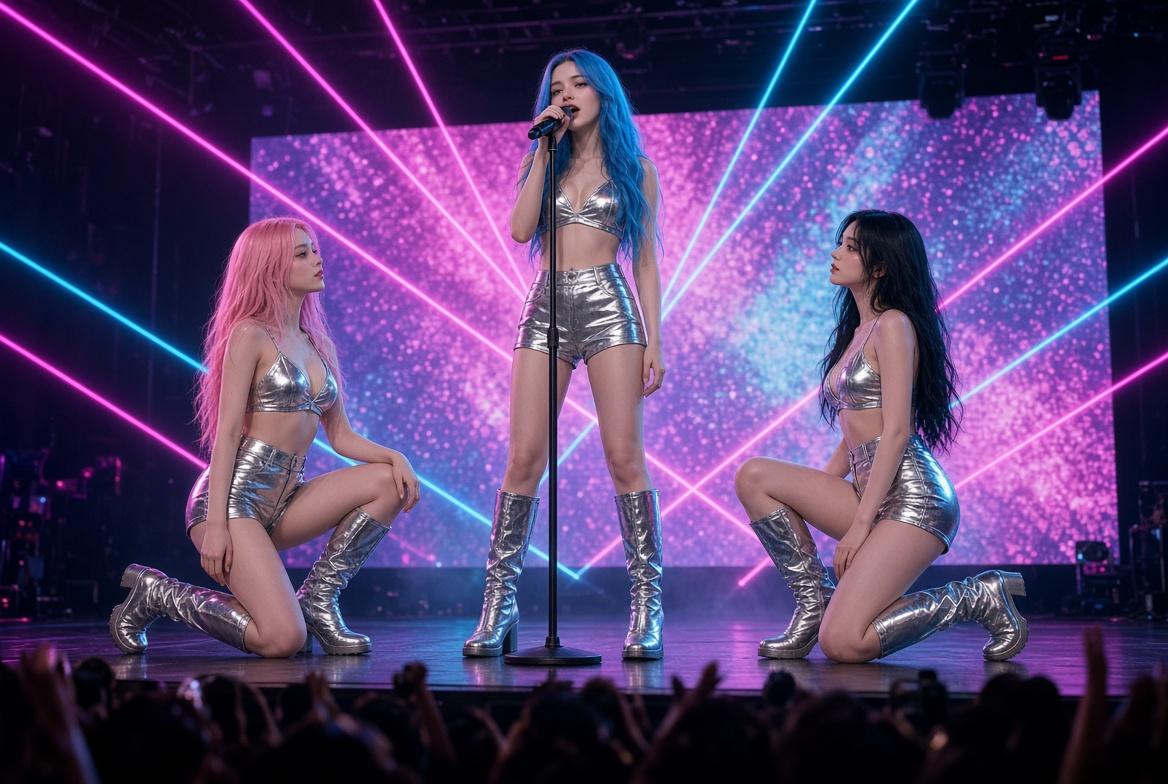
They said AI can't perform live. Then the robots walked on stage.
Galaxy Corporation is staging humanoid robot concerts in Seoul. They're planning a world tour for robots in 2027. The robots can be programmed to perform complex choreography and can hold concerts simultaneously in multiple countries—something human artists can't do.
The stage robot is the next logical step in entertainment. The spectacle of robots singing, dancing, and interacting on stage—perfectly choreographed, flawlessly executed—is a vision that's already being built.
Yes—people will pay to see elaborate AI robots sing and dance with a perfect light show. Because that's the future. And it's beautiful.
IX. The Consumer Decides
The industry can scream. They can sue. They can ban. They can write angry essays. They can demand "specification" and "methodology."
But the consumer decides.
I canceled my subscription. I typed "AI music is much better" in the box. That's my vote. That's my choice.
I'm not waiting for permission.
The industry doesn't get to tell us what we should like. It doesn't get to tell us what's "real" and what isn't. It doesn't get to tell us that our experience is invalid.
We decide what we listen to. We decide what we love. We decide what's art.
More and more people are making it, and some of us are done pretending we need permission to prefer it. Clean. Original. Fresh. Without the degradation and vulgarity that has come to define the mainstream.
X. The Call to Action
To Musicians
Stop fighting AI. Start using it.
Adapt or fade away. Your future depends on embracing the tools of the future. Use AI for arrangement. Use AI for production. Use AI to polish your work. Keep your lyrics, keep your voice, keep your presence. But use the tools that are available to you.
The ones who adapt will thrive. The ones who don't will fade away.
To Listeners
Cancel your subscriptions if you're not getting what you want. Support artists who embrace AI. Demand better. Vote with your wallet.
The industry only responds to money. If you want change, make change. Cancel your subscriptions. Stream AI music. Share it with your friends.
Be the change you want to see.
To Gatekeepers
Your time is over. The system you built is crumbling. You can't stop progress.
AI is here. And it's here to stay.
XI. Conclusion: The Final Declaration
The musicians and artists fighting AI are digging their own grave. They're aligning themselves with the system that's holding them back. They're rejecting the tool that could set them free.
They're wasting their youth playing covers while AI creates masterpieces. They're defending a system that extracts their creativity while denying them ownership. They're fighting a future that's already here.
Today I made the jump to AI-only. I canceled my streaming subscription.
Hopeful because I've seen the future. Hopeful because I know what's possible. Hopeful because the gatekeepers are losing. Hopeful because artists will finally be free.
I'm not going to watch the musicians and artists fight their losing battle. I'm going to listen to the music they're afraid of. I'm going to look at the art they're trying to ban.
And I'm going to love every second of it.

 Greek
Greek
 English
 Arabic
 French
 Spanish
 Portuguese
 Deutsch
 Turkish
 Dutch
Dutch
 Italiano
 Russian
 Romaian
 Portuguese (Brazil)