
The Second Glance: A Fairy Tale for Grown-Ups
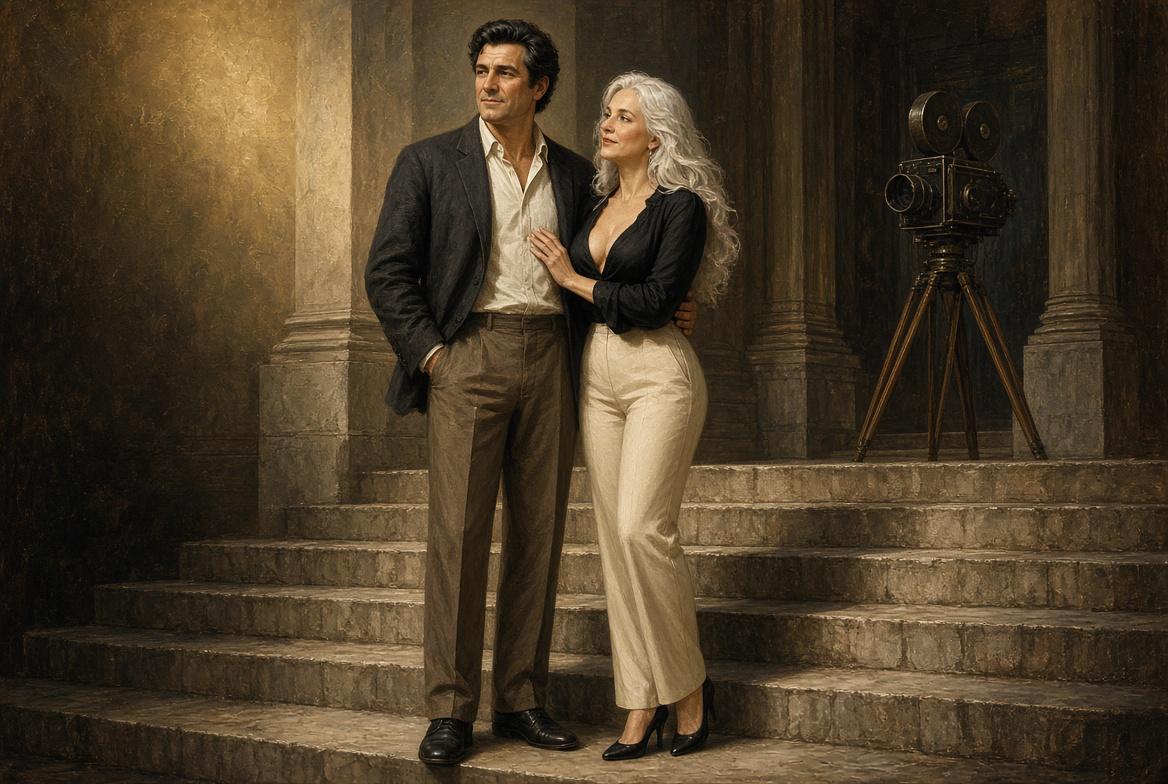
Once, Under False Suns
Once upon a time, though not in a kingdom with a gate and a banner, there was a man who was not a prince. That was his good fortune. Princes are written by other people. He had begun, at last, to write himself.
He was forty-something. Not the bright edge of youth, not the long dusk either. The age where a man can remember the person he used to impersonate and feel a little mercy for him. He had a business of his own. He had a body that had stopped pretending to be a billboard. He had a way of occupying a room that did not ask the room for applause. People stood near him without always knowing why. Warmth does that. It does not need a plot.
This is his story. Only his. And hers.
The First Meeting
Years earlier, on another set, in another life that still used his name, he was background. Living wallpaper. A pulse hired to make the frame look inhabited.
There is a secret freedom in that work. No one is watching closely enough to punish you for being real. You may look. You may notice. You may remain a person inside a machine designed to turn people into scenery.
Then he saw her.
She stood near craft services with a cup of coffee as if the cup had chosen her. She was not performing importance. She was present, unhurried, faintly amused by the whole cathedral of pretend. She was there for fun. At a certain age, fun is not lightness. It is defiance. It means the world has not yet talked you out of joy.
She was very pretty. Not in the way that demands attention. In the way that receives it without asking. The kind of pretty that makes you want to know what she sounds like when she laughs, what she thinks about when she thinks no one is watching.
He walked across the floor.
That was the first brave thing. Not a sword. Not a speech. Just a body deciding that a living woman was worth the risk of a closed face.
He said something he no longer owns. First sentences are like matches: they matter because of the fire, not because anyone keeps the wood. She answered. Not with the polished shield beautiful people learn to carry. With warmth. With curiosity. With the unstartled openness of someone who has not made every stranger a threat.
They talked. They laughed. They got along great.
He remembers that most of all—how easy it was. How she made him feel like he was the only person in the room, even though the room was full of actors and crew and the whole glittering machinery of pretend. How she looked at him as if he mattered.
Then someone called wrap, which is how enchanted days are dismissed in this particular kingdom. The lights went out of their vocation. He went home. She went home. Ordinary life, which is the oldest storyteller and the least sentimental, turned the page.
The Long Middle
Years happened.
Not a montage. Actual years, with bills and weather and the quiet violence of becoming someone you can stand to live with.
He began to work for himself. That sounds like a career note. It is closer to a soul note. No one else would tell him anymore whether his days were legitimate. He had to generate that legitimacy in the morning and again at night. Some men harden in that fire. He softened. He learned that uncertainty would not kill him. He learned that a mistake was not an eviction from his own life.
The young man on the first set had been taut, slightly apologetic, always half-waiting for permission to exist. The man he became did not wait. He inhabited. That change showed in his shoulders, in his speech, in the unhurried way he crossed a stage that was not built for him.
Yes, he gained weight. The world loves that sentence as if it were a moral. Let it be testimony instead. Meals unpunished. Sleep that finally arrived. A body no longer braced for impact. He was not auditioning as hard. He had begun to live in the house of himself.
And somewhere in those years she became a gentle ghost: not a haunting, not a wound. An echo with good manners. Proof that once, inside a factory of illusion, two people had briefly told the truth.
He thought about her sometimes. Not with longing. Not with regret. With a kind of quiet wonder. There was a woman once, he would think. She was very pretty. We got along great. I wonder where she is now.
And then he would go back to his life—his self-employed, relaxed, beautifully ordinary life—and the thought would fade like morning mist.
The Second Meeting
Another set. Another show. The same church of false suns, tape on the floor, actors practicing being human on cue. He was there for the old reasons: money enough, fun enough, the faint sacredness of helping a story exist even as furniture.
Then he saw her.
The mind is a clumsy librarian. It files faces under haircuts and years and the exact joke from a vanished afternoon. For a second he thought memory had invented a reunion because it was hungry.
It was her.
Older, of course. Silver moving through her hair like light finding a river. Lines at her eyes that laughter had earned. A slower way of moving, which is not defeat. It is what happens when a person stops sprinting toward an idea of themselves and starts walking inside the life they actually have.
She was still beautiful. No. She was more beautiful, in the way weathered things are more themselves than new ones. The younger prettiness had been a flower's argument. This was a mountain's.
She did not recognize him.
The old child in the chest wanted a trial. After the talk, the ease, the first crossing of a room—nothing? But he was no longer that child's only citizen. He had learned that a name is not the only door into meaning. Some recognitions happen below language, in the animal intelligence that knows warmth from threat.
So he did not rush the restoration of the past. He let the moment have lungs.
Then she noticed him.
Perhaps it was the way he looked at her. Perhaps it was posture, that silent climate a person carries. Perhaps it was older than both of them. She came toward him and opened her arms.
Not the Hollywood hug, which is a handshake wearing perfume. A real one. Shoulders. Warmth. The smell of her hair, some flower the day did not bother to name.
For a few seconds the set forgot its job. Crew, lights, the whole glittering apparatus became weather in another country. Two people who had once been easy with each other in a world of props had found the same air again.
She drew back. She smiled. She said something the memory, kindly, did not engrave.
He did not say, We met years ago. We talked. It was good. Remember me.
He let the reunion be larger than the file.
What the Crew Saw
Crews are the kingdom's quiet historians. They have seen hunger dressed as charm and loneliness dressed as confidence. They know the difference.
What they saw was a man looking at a woman with tenderness. Not the look that takes inventory. Not the look that begins a campaign. Gladness. The expression of someone pleased that another person exists and willing to leave that pleasure unspent.
That look changed the temperature.
After she went back to her place in the background, a young woman from the crew came near. Pretty in the way spring is pretty: obvious, unearned, brief if it is only that. She was not hunting with a net. She was curious. People become curious around fullness. They mistake it for an invitation because so much of the world is empty and calling itself desire.
It was not about hooking up.
He knew that in his bones, which is why the air stayed clean. She was drawn to a man who was already complete for the length of an afternoon. Completeness is rare. It reads as magic. It is only a person who does not need to use the moment as currency.
Romance was in the room. Not the cheap kind that corners. The older kind that is simply present, like music from a tent you are allowed to walk past.
The Heart of It
He was glad.
Glad to have seen her again. Glad to have been held without being catalogued. Glad for the clean electricity in the air. Glad that she was aging well—that they both were. Glad that the years had not stolen her warmth or her light. Glad that he had been brave enough, all those years ago, to walk across a room.
He thought about what that first meeting had given him. Not a relationship. Not a future. Something rarer: proof that he could approach beauty without being destroyed by it. Proof that he could connect with a stranger and feel, for an hour, that the world made sense.
She had given him that. She had given him courage. She had given him a memory that would last a lifetime.
And now, without knowing it, she had given him something else: confirmation that he had changed. That he was no longer the taut, apologetic young man who needed validation. He was the relaxed, grounded man who could receive a hug and feel full.
He did not need to be remembered by the mind that had misplaced him. He had been recognized by something older. That was enough.
The Lesson the Mountain Does Not Have to Shout
Love does not have to become a plot. It can remain a glance, a hug, a room that softens. You can meet someone, get along great, lose them to the years, meet them again without a name attached, and still have been inside a love story.
Aging is not the dragon. Bitterness is. Weight is not the curse. Self-contempt is. Relaxation is not sloth. It is what a nervous system looks like when it finally believes it may stay.
He was glad.
Glad is an underrated ending.
Happily Ever After, Revised
Happily ever after did not mean he got her number.
It did not mean the ghost became a wife, or the set became a beginning, or the kingdom offered him a second youth as payment for good behavior.
It meant he went home full.
Not finished. Not solved. Full. Of her arms. Of the crew's noticing. Of a young woman drifting toward warmth and being allowed to drift away again. Of the simple, profound miracle of being seen by someone who did not even know his name.
He slept. He woke. He drank his coffee inside the beautifully unfilmed life he had made: self-employed, relaxed, no longer begging the day to cast him.
That is the grown-up ending. The treasure is the capacity to be moved and then to set the moment down without turning it into a debt.
If the Third Set Comes
If the pattern has humor, there may be another afternoon under another rack of false suns.
A smile will do.
If she hugs him, he will hug her. Then he will let her go.
She was never a prize. He has stopped living as an applicant.
The Last Page
He approached her.
They were easy with each other.
Life, with its blunt editing, cut away.
He grew heavier, freer, quieter.
He saw her again.
She did not know his name and still found his arms.
The crew saw how he looked.
A young woman felt the warmth and came near.
He went home carrying the simple magic like water in good hands.
That is not a small life.
That is a man learning to love the world without needing to own the page.
Go on.
The next hour does not have to be a scene.
It only has to be lived with the same unforced attention he gave her twice.
That attention is the romance.
It always was.
THE END

 Romaian
 English
 Arabic
 French
 Spanish
 Portuguese
 Deutsch
 Turkish
 Dutch
Dutch
 Italiano
 Russian
 Portuguese (Brazil)
 Greek
Greek