
Deconstructing Madonna’s Lecturing at Coachella
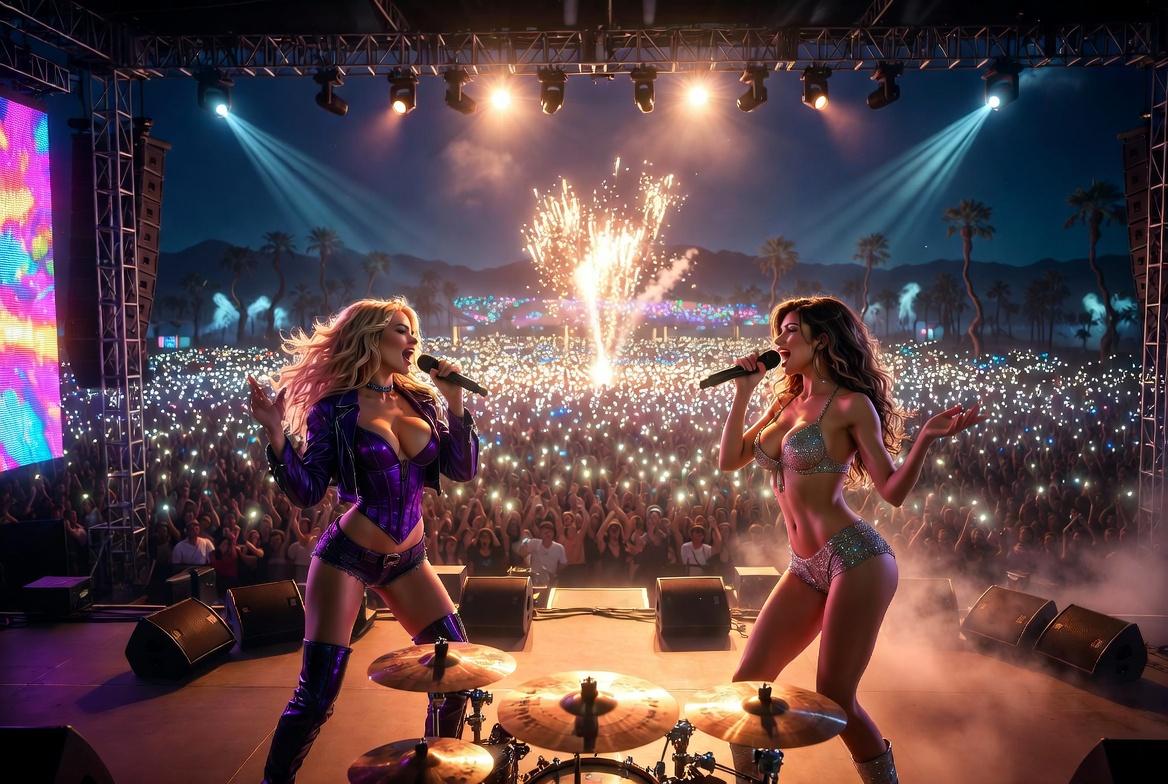
The desert air of Indio, California, is typically reserved for hedonism, surprise drop-ins, and the gentle thrum of bass. The Coachella Valley Music and Arts Festival has long been a sanctuary where the pressures of geopolitics dissolve into the spectacle of celebrity. However, during the second weekend of April 2026, the vibe was momentarily punctured—not by a technical malfunction or a security breach, but by a lecture. When Madonna emerged from beneath the stage during Sabrina Carpenter’s headlining set, the audience expected a coronation. What they got, according to a growing chorus of critics and bemused social media users, was a sermon: a sad, scolding, and ultimately rude interruption of a young pop star’s victory lap.
While die-hard fans praised the "full circle" moment of Madonna reprising her Confessions era , a significant segment of the audience and online commentators felt that the Queen of Pop had overstayed her welcome within the brief five-minute slot. From astrological lectures about war to subtle jabs at the younger generation’s height and work ethic, the performance felt less like a passing of the torch and more like a bitter faculty meeting interrupting a spring break party. This essay argues that Madonna’s Coachella appearance, while historically significant, was marred by a tone-deaf lecture that highlighted a growing disconnect between the icon’s self-perception and the audience’s desire for pure, uncomplicated entertainment.
The Context of the Coronation
To understand why the audience felt a whiplash of annoyance, one must first appreciate the setting. Sabrina Carpenter was not just any performer; she was the moment. Having ascended from Disney darling to Grammy-winning headliner, Carpenter represented the new blueprint of pop: witty, visually immaculate, and sonically light . Her set was a celebration of "Short n' Sweet" energy—playful, raunchy in a cartoonish way, and entirely devoid of pretension.
When Madonna appeared, the crowd erupted. For a few minutes, the fantasy held. They performed "Vogue," and the decades melted away. Carpenter, ever the gracious host, bowed to the altar of Madonna, telling her, "No thanks needed, Madonna, you can have whatever you want" . It was the ultimate co-sign. As one fan put it, “If Madonna acknowledged her, it means Sabrina is the real deal now” . However, the power dynamic was always going to be tricky. When you invite a lion into your living room, you accept that the lion might eat the furniture. In this case, the furniture was the carefree vibe of the festival.
The Astrology of Discontent
The trouble began when the music stopped. In a festival setting, silence is the enemy. It breeds anxiety. It allows the sunburn and the $20 beers to feel heavy in the stomach. Madonna, seemingly unaware of this, launched into a discourse on astrological determinism that felt wildly out of place.
Addressing a crowd of over 100,000 people who had just been screaming for "Espresso" and "Juno," Madonna warned about the perils of conflict. Citing the position of the stars, she noted that the audience should be wary of confrontation because "Aries is dominated by Mars which is the planet of war" . She urged the masses to "try to get along" and "avoid disagreement" for the rest of the month .
On paper, advocating for peace is noble. In practice, at a music festival in 2026, it was received as patronizing. The audience at Coachella is not a UN summit; they are people in flower crowns and cowboy boots trying to forget their student loans and the grim news cycle for a weekend. By instructing them to be peaceful, Madonna implied that they were inherently incapable of it without her guidance.
Furthermore, the specific mention of "Aries season" and "Mars" had a condescending flavor. It implied a level of mystical wisdom that the "kids" just don’t possess. In an era where celebrity activism is increasingly scrutinized for being performative, reducing the complexities of war to a horoscope reading felt reductive and, frankly, rude to the intelligence of the listeners. It was the equivalent of a substitute teacher walking into a room and telling everyone to sit up straight because the alignment of Jupiter said so.
The "Sad" Aesthetic: A Clash of Eras
Beyond the words, there was the visual and emotional texture of the moment. Social media users described the interaction as "cringeworthy" . Why? Because of the inherent sadness of watching a legend try to assert dominance over a rising star.
Madonna has built her career on reinvention and ruthlessness. But at 67, standing next to the 26-year-old Carpenter, the dynamic shifted from "mentor" to "jealous ex." This was exacerbated by her attempt to reprise her 2006 Confessions outfit—the same boots, the same corset, the same Gucci jacket . While intended to signal timelessness, it signaled a refusal to evolve. It is one thing to be an icon; it is another to refuse to leave the building.
The "sadness" critics refer to is not pity; it is the discomfort of witnessing arrested development. Madonna took a moment that was supposed to be about Carpenter’s mainstream validation and made it about her own legacy. She spoke at length about her 2006 performance, her "full circle" moment, and her own upcoming album, Confessions II . When a surprise guest spends more time talking about their own album than hyping up the host, the audience begins to feel like they are being held hostage.
One of the most telling moments of rudeness was disguised as a joke. Madonna thanked Carpenter for "giving her the opportunity to sing next to someone shorter than her" . While Carpenter laughed it off, the comment carried a sharp edge. It was a power play. By calling out the height difference, Madonna visually framed Carpenter as "less than"—smaller in stature, smaller in legacy, smaller in importance. In the world of pop divas, this is the equivalent of a backhanded compliment, and it sucked the air out of the generational celebration.
The Politics of the Dance Floor
Madonna’s lecture on "avoiding confrontation" was not just astrology; it was a thinly veiled political statement. Sources noted that the comments regarding Mars and war were implicit references to the military-industrial complex and the Trump-era political landscape . Madonna has a long history of political provocation, but historically, she did it with art—burning crosses, kissing Britney, wearing crucifixes.
At Coachella, she opted for a lecture. She insisted that "music is the only place where people can put their differences aside" . This is a beautiful sentiment, but it rings hollow when delivered in the middle of a set that felt so transactional. She wasn't uniting people; she was talking at them. Cyndi Lauper, a peer of Madonna’s, once criticized the singer’s speech style, noting, "Anger is not better than clarity and humanity" and that "Yelling just jacks people up" . At Coachella, Madonna wasn't yelling, but she was lecturing—and the result was the same: it jacked people up.
The rude awakening for the audience was the realization that Madonna viewed the Coachella stage not as a party, but as a pulpit. She claimed that the dance floor "is not just a place, it’s a threshold: A ritualistic space where movement replaces language" . Yet, by stopping the music to lecture, she violated her own manifesto. She replaced movement with her own language, and in doing so, broke the spell.
The Technical Slights and The Lip-Sync Scandal
Adding to the perception of "rudeness" was the technical execution of the performance. In an era of raw, unfiltered live singing (largely pushed by artists like Sabrina Carpenter, who was praised for her live vocals), Madonna was accused of heavy reliance on backing tracks and lip-syncing .
Social media was ruthless. One user posted, "Wait why were both her and Madonna lip syncing during this performance?" Another noted that Madonna was "helped" by a very high volume backing voice track, arguing that to call it live singing would be a stretch . For an artist who built her reputation on the grit of Truth or Dare and the vocal strain of "Like a Virgin" at the MTV Awards, showing up to a live festival with a karaoke track is the ultimate sign of disrespect to the audience.
It suggests that the audience’s time and money are not worth the risk of a cracked note. It suggests that the performance is purely a branding exercise. When you combine the lip-syncing allegations with the lecturing, a damning picture emerges: Madonna wanted the credit for appearing without the vulnerability of performing. She wanted to be heard but refused to sing. That is the definition of rude.
The "Stubborn" Label: Projection or Perception?
In a moment of interaction, Madonna called Sabrina Carpenter "stubborn" . In the context of the evening, it felt like a put-down masked as affection. It implied that Carpenter had some edge that needed smoothing—presumably by Madonna herself.
But who was really being stubborn? It was Madonna who was stubbornly clinging to a narrative of victimhood and sage-wisdom that the market no longer wants from her. The audience came to see a queer, joyful celebration of pop. Instead, they got a lecture on geopolitics and a reminder of who built the stage they were standing on. That is like a landlord showing up to your housewarming party to remind you that the pipes are his.
The "sad" element of the evening was the desperation. At 67, Madonna is still chasing the dragon of cultural relevance. She is releasing Confessions II, a sequel to a 20-year-old album, and she felt the need to announce it not through a killer single, but through a lecture at someone else’s concert . It was a marketing strategy that prioritized legacy over joy.
The Audience Pushback
The reaction on X (formerly Twitter) was swift and merciless. While some celebrated the "passing of the torch," the negative comments were visceral. One user succinctly stated that Madonna "needs to retire" because "she sounds horrible" . Another commented on her outfit, demanding she "put some clothes on and cover her stuff up," referencing the age-inappropriate (in their view) purple corset and shorts .
These comments, while sometimes ageist, speak to a deeper discomfort. The audience feels that Madonna is breaking the social contract of the "Elder Stateswoman." We expect our legends to be like Dolly Parton or Elton John—gracious, supportive of the new generation, and wise without being preachy. Madonna refused that role. She came to Coachella to fight, and when you fight at a party, you are the one who looks sad.
The most viral criticism labeled the moment "cringeworthy bullsh-t theatre crap" . That is a damning indictment. It suggests the performance failed on its own terms. It wasn't shocking enough to be art, nor was it clean enough to be a hit. It was just a weird, tense few minutes where a young star had to awkwardly wait for her elder to finish scolding the audience about the stars.
Conclusion: The Party vs. The Pedestal
Coachella is, at its core, a transaction. The audience pays a premium to escape. In exchange, the artists are paid to facilitate that escape. Sabrina Carpenter understood this; her set was a confection of sugar, spice, and everything nice. Madonna, however, arrived with a plate of vegetables and a lecture on nutrition.
The "sad and rude lecturing" of Madonna was not just about the content of her speech—the astrology, the politics, the peacemongering. It was about the context. It was rude to interrupt the euphoria of a young queen’s coronation to demand respect for the old queen’s reign. It was sad to watch a legend believe that the only way to stay relevant was to talk down to an audience that was initially ready to worship her.
By attempting to heal the world with a five-minute monologue in the desert, Madonna revealed a tragic flaw: she has forgotten how to just be fun. In her quest to remain the provocative, boundary-pushing artist of the 90s, she has become the very thing she once fought against: the boring adult telling the kids to turn the music down.
As the final notes of "Like a Prayer" faded and Carpenter took back the reins, the audience breathed a sigh of relief. The lecture was over. The party could resume. But the memory lingered—a reminder that even the greatest icons can sometimes be the worst guests. Madonna wanted to be the teacher, but at Coachella 2026, the class was not in session. The students had shown up to dance, and they were right to feel that being told to "avoid confrontation" by a woman wearing a lavender corset and a microphone was, perhaps, the most confrontational and unnecessary act of the entire weekend.


 English
 Arabic
 French
 Spanish
 Portuguese
 Deutsch
 Turkish
 Dutch
Dutch
 Russian
 Romaian
 Portuguese (Brazil)
 Greek
Greek