The Situation: Fake or Real? (The Rich Girl Edition)
Prologue: The Circus Arrives in Town
Let us begin with a confession.
I have spent exactly forty-seven minutes of my life reading comment sections about a twenty-year-old rich girl's body. Forty-seven minutes I will never get back. Minutes that could have been spent learning a language, calling my mother, or simply staring at a wall in peaceful silence. Instead, I was waist-deep in the digital sewer, watching grown adults argue about whether a stranger's breasts are "factory original" or "aftermarket."
And here is the secret nobody wants to admit:
None of this actually matters.
Not one single pixel of it.
She is twenty years old. She is rich beyond the wildest dreams of anyone reading this sentence. She is young. And she is hot. Not "cute for a reality adjacent person" hot. Not "nice personality" hot. She is the kind of hot that stops scrolls dead. The kind of hot that makes people zoom in like they're analyzing the Zapruder film. The kind of hot that inspires thousand-word Reddit breakdowns comparing a bikini photo from 2022 to a bikini photo from 2024, as if she is a fugitive and they are forensic analysts.
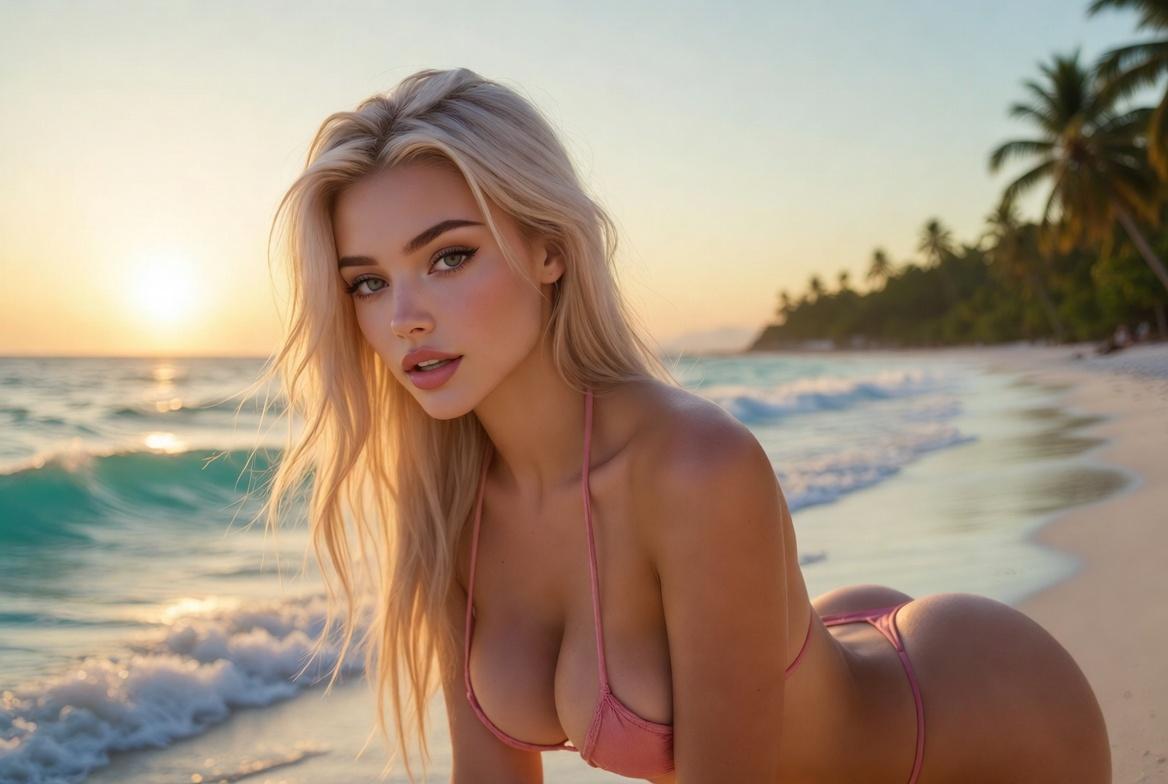
She drops images on the internet: tiny strings, perfect angles, everything pushed up and out exactly right. Those lips are plump, glossy, and freshly filled. Her father is a tattooed rock god, a plane-crash survivor, a drummer with a wallet thicker than most people's retirement accounts. Her mother is a former beauty queen, built like a centerfold, genetically blessed in ways that make people angry at the universe's unfair distribution of good bone structure. And the reality television connection? That is the infinite money glitch. That is the cheat code that makes her entire world smell like luxury and private beaches and things you will never touch.
So what the hell are we even arguing about?
Did she get lip filler? Yes. She openly admitted this. It is a fact. It is not in dispute. Did she get more? Nose, cheeks, chin, breasts, butt? Maybe. Maybe not. Who knows? Who cares?
She is not your daughter. She is not your girlfriend. She is not your wife. She is not asking you to foot the bill. She is not asking for your permission. She is not asking for your moral approval. She is simply existing in public, posting from a private beach or her father's mansion, while you are reading this on your phone in a waiting room or on your couch or, let's be honest, on the toilet.
She won. Game over. The credits have rolled. The fat lady has sung. Pack it up and go home.
But we are not going home, are we? Because the circus is too entertaining. Because the human brain is a gossip machine wrapped in a meat suit. Because we cannot look away from a train wreck, even when the train wreck is just a beautiful young woman living her life while the internet loses its collective mind.
So before we move on, let us actually learn something from this circus. Because if we are going to stare — and we are, we absolutely are — we might as well understand what we are staring at. We might as well come away with something useful, something that applies to our own lives, something that saves us money and heartache and regret.
Consider this your guided tour through the madness. A map of the funhouse. A flashlight in the dark carnival of celebrity body speculation.
Part One: The Biology of Not Being a Forensic Analyst
Let us start with some actual science, because most people have no idea how much the human face and body change between the ages of twelve and twenty. And that ignorance fuels ninety percent of the "plastic surgery!" panic that fills comment sections and tabloid headlines.
Bone structure keeps developing until age twenty-five.
This is not a fun fact. This is a foundational truth of human biology that everyone seems to have forgotten. The mandible — that is your jawbone, for those of you who skipped anatomy — continues to grow forward and widen well into your early twenties. The cheekbones become more prominent. The brow ridge shifts. What looks like a "new face" is often just a face that finished cooking.
Think about that for a moment. Every time you see a celebrity transformation slideshow comparing a sixteen-year-old to a twenty-two-year-old, you are not looking at evidence of surgery. You are looking at puberty taking its sweet, slow, agonizing time. The skeleton does not snap into its final form on your eighteenth birthday. It keeps going. It keeps shifting. It keeps changing.
If you took a photo of yourself at fourteen and a photo of yourself at twenty-two, you would also look different. Your jaw would be sharper. Your cheekbones would be more defined. You would not look like the same person, because you are not the same person. You are a later draft. A revised edition. An updated software version.
The fat pads in the face redistribute dramatically.
Teenagers have what dermatologists call "buccal fat." These are the round, soft, squishy cheeks that make young faces look young. They are adorable on a toddler. They are charming on a high school freshman. But between the ages of eighteen and twenty-five, that fat naturally migrates and shrinks. It does not disappear entirely, but it changes location. It moves. It shifts.
The result? Cheekbones appear where there were none. The jawline sharpens from soft to sculpted. The face looks leaner, more angular, more adult. This is not surgery. This is the natural aging process. This is your face losing its baby fat, the same way your body lost its baby rolls.
Every week, some celebrity gets accused of "buccal fat removal surgery" because their cheeks look different than they did at sixteen. And ninety percent of the time, they just... aged out of their baby fat. They grew up. Their face changed. That is what faces do.
Our subject went from fourteen to twenty. That is six years of facial fat loss. Six years of bone development. Six years of her face rearranging itself according to the genetic blueprint she was born with. It explains a lot. It explains most of it, actually.
Lips thin with age but can also appear fuller due to other factors.
Here is something counterintuitive, something that sounds like a paradox but is actually simple biology: while lips naturally lose volume over a lifetime, they can look fuller in a teenager's early twenties compared to her early teens simply because the surrounding face has leaned out.
Think of it this way. If you have a grape sitting in a bowl of oatmeal, you cannot really see the grape. It is buried. It is lost. But if you remove the oatmeal, that same grape looks prominent. It looks bigger. It stands out.
That is what happens to lips when the surrounding facial fat decreases. Less fat around the mouth makes the lips pop more. The lips themselves have not changed size. Everything around them has changed. The context has shifted.
That said, our subject admitted to lip filler. So that one is settled. She got filler. She told us she got filler. There is no mystery here. There is no investigation needed. She said yes, and we can all move on with our lives.
Breasts continue developing into the early twenties.
This is the part nobody talks about. This is the biological fact that gets left out of every single "before and after" slideshow. Breast development does not magically finish at eighteen. It does not stop when you graduate high school. It does not freeze in place when you get your driver's license.
For many women, significant changes happen between eighteen and twenty-two. Sometimes a full cup size or more. Sometimes significant changes in shape, density, and projection. Genetics plays a role. Weight fluctuations play a role. Hormonal birth control plays a role. Overall body composition plays a role. Everything plays a role.
So when you see a twenty-year-old with a fuller chest than she had at seventeen, the first explanation should not be "she went under the knife." The first explanation should be "she is still developing." That is the default. That is the null hypothesis. That is the boring, normal, non-scandalous answer that accounts for the vast majority of cases.
But boring does not sell clicks. Boring does not generate outrage. Boring does not fill comment sections with angry men and concerned women and white knights and haters and everyone in between. So the boring answer gets ignored. The boring answer gets shouted down. The boring answer loses to the exciting accusation of secret surgery.
Weight fluctuations change everything.
Our subject has publicly discussed having an autoimmune condition. She has discussed thyroid issues. Both of these things can cause significant weight gain and loss. Both of these things can send a body on a roller coaster that has nothing to do with diet or exercise or willpower.
When you gain weight, your breasts get fuller. Your face softens. Your hips widen. Your entire silhouette changes. When you lose weight, your jawline sharpens. Your cheekbones emerge. Your waist cinches. Your collarbones become more prominent.
These are not surgical effects. These are not evidence of "work." These are just bodies being bodies. Human bodies are not static. They do not freeze in place at a certain age and never change again. They shift. They fluctuate. They respond to hormones and illness and medication and stress and a thousand other variables.
If you took photos of yourself at different weights, you would also look different. You would also have people asking "what did you do?" And the answer would be nothing. You just lived. Your body just did what bodies do.
Part Two: The Procedure Reality Check (Or, How to Spot the Difference Between a Spa Day and Major Surgery)
Now let us talk about what actual plastic surgery involves. Because there is a world of difference between lip filler — which is not even surgery, which is barely a medical procedure — and a surgical breast augmentation or a Brazilian butt lift.
Lip filler: $500 to $1,000 per syringe. Lasts six to eighteen months. Takes fifteen minutes.
There is no scalpel. There is no general anesthesia. There is no recovery time beyond some swelling that goes away in a day or two. You can get lip filler on your lunch break and be back at your desk in an hour. It is not surgery. It is the cosmetic equivalent of getting your nails done — just slightly more expensive and slightly more controversial for reasons nobody has ever adequately explained.
Our subject admitted to lip filler. She was honest about it. She did not have to be. She could have lied. She could have deflected. She could have said "I just woke up like this." Instead, she said yes, I got filler, and that was the end of it.
And yet the speculation continues. Because once you admit to one thing, people assume you are hiding ten other things. Once you give them an inch, they take a mile. Once you tell the truth about the small thing, they assume you are lying about the big things.
Breast augmentation: $5,000 to $15,000. Requires general anesthesia. Involves cutting through tissue. Recovery time of four to six weeks.
This is major surgery. This is not a lunch break procedure. This is not something you do on a whim. You go under general anesthesia, which carries its own risks. The surgeon makes incisions. They create pockets — either under the gland or under the muscle. They insert the implants. They close you up. You wake up groggy, in pain, with drainage tubes and compression garments and a long list of things you cannot do.
The recovery is brutal. You cannot lift your arms above your head for weeks. You cannot drive. You cannot sleep on your stomach. You cannot return to normal activities for at least a month. And that is assuming everything goes perfectly.
Because things do not always go perfectly. There are real risks. Capsular contracture — that is when scar tissue squeezes the implant, making it hard and misshapen. Rupture — the implant breaks, leaking silicone or saline into your body. Infection — always a risk with any surgery. Loss of nipple sensation — permanent numbness. And the implants themselves are not lifetime devices. They need to be replaced every ten to fifteen years, sometimes sooner.
Breast augmentation is not a small decision. It is not a casual tweak. It is a serious medical procedure with serious consequences and serious long-term commitments.
Brazilian butt lift: Even more dangerous.
Let me be very clear about this. The Brazilian butt lift has one of the highest death rates of any cosmetic procedure. Why? Because fat injected into the buttocks can travel to the lungs and cause fatal embolisms. The needle hits a blood vessel, fat enters the bloodstream, and suddenly you are having a pulmonary embolism on an operating table.
Reputable surgeons warn against this procedure. Some countries have banned it entirely. The recovery is brutal — you cannot sit normally for weeks. You cannot lie on your back. You have to sleep on your stomach or standing up or in some complicated arrangement of pillows that makes normal rest impossible.
This is not a casual Tuesday afternoon tweak. This is not something you do because you want to look better in leggings. This is a dangerous, high-risk procedure that has killed people.
Why does this matter?
Because when people casually say "she definitely got her boobs done" or "that's a BBL" or "look at her nose, that's clearly surgical," they are accusing someone of undergoing serious, risky, invasive surgery. That is a heavy accusation. That is not a neutral observation. That is a claim about someone's medical history.
And it is often made with zero evidence. Zero. Just "she looks different than she did at fourteen." As if fourteen-year-olds and twenty-year-olds are supposed to look identical. As if puberty does not exist. As if makeup and lighting and angles and weight fluctuations are not real things that affect appearance.
Our subject has denied any cosmetic work to her body. Given the risks and recovery involved, and given that she has been open about the lip filler — why would she lie about the rest? If she is willing to admit to one thing, why would she deny another? Occam's razor applies here: the simplest explanation is usually correct.
She grew up. She lost baby fat. Her body changed. She learned makeup. She got good lighting. She figured out angles. She found a push-up bikini top that does God's work. And yes, she got lip filler. That is probably the whole story.
But probably is not good enough for the internet. Probably does not generate outrage. Probably does not fill comment sections. So the speculation continues. The accusations fly. The circus rolls on.
Part Three: A Personal Opinion Against Surgery (Delivered With Sass)
Let me say this plainly, clearly, and without hedging:
I am against cosmetic surgery.
Not for moral reasons. Not for religious reasons. I do not think it is sinful. I do not think it is shameful. I do not think people who get surgery are bad people or weak people or shallow people.
I am against it for practical and aesthetic reasons. And I think the culture pushing young people toward it is toxic, predatory, and destructive.
The long-term costs are rarely discussed.
That breast augmentation at twenty-two will need maintenance at thirty-five, replacement at forty-five, and ongoing monitoring for the rest of your life. Implants are not lifetime devices. They are ticking clocks. They have expiration dates. And the longer they stay in, the higher the risk of complications.
Most twenty-year-olds getting surgery are not thinking about what their bodies will need at fifty. They are not thinking about the second surgery, the third surgery, the fourth. They are not thinking about capsular contracture or rupture or infection or any of the other things that can go wrong. They are thinking about how they will look in a bikini next summer.
I get it. I understand the impulse. But the long-term costs are real, and they are rarely part of the conversation.
The results often look worse over time.
A facelift at forty-five might look great. The same facelift at sixty-five? Often tight, unnatural, and obvious. The skin does not age the same way around the surgical alterations. The underlying bone and soft tissue keep changing while the surgical changes remain frozen in time.
Ten years after a nose job, the nose might look fine, but the rest of the face has shifted. New imbalances appear. New asymmetries emerge. What looked good at twenty rarely looks natural at forty. What looked good at forty rarely looks natural at sixty.
Surgery is a bet against time. And time always wins.
The psychological angle is uncomfortable.
Why do we need to change our faces and bodies so badly? What are we running from? What are we trying to escape?
The answer is usually not pretty. Social media comparison. Internalized insecurity. Fear of aging. Fear of being unattractive. Fear of being overlooked. Fear of being forgotten. And a beauty industry that profits directly from making us feel inadequate, that spends billions of dollars convincing us that we are not enough, that we need to be fixed, that our natural faces are unacceptable.
Surgery treats the symptom, not the cause. It changes the outside without touching the inside. And for many people, surgery does not actually fix the insecurity — it just moves it to a new feature. You fix your nose, and now you hate your chin. You fix your chin, and now you hate your cheeks. You fix your cheeks, and now you hate your lips.
Studies show that plastic surgery patients often remain dissatisfied because they were chasing an external fix for an internal problem. The problem was never the nose. The problem was never the chin. The problem was the feeling of not being enough, and no amount of cutting and stitching can fix that feeling.
Natural variation is beautiful.
The pressure to all look the same — same plump lips, same ski-slope nose, same high cheekbones, same exaggerated hip-to-waist ratio — is flattening human diversity into a single boring template. It is erasing everything that makes faces interesting, everything that tells a story, everything that makes someone recognizable.
The most interesting faces are the ones with character. Asymmetry. Uniqueness. A nose that is slightly crooked. A smile that is slightly uneven. A face that looks like it has lived, that has experienced things, that belongs to someone specific rather than a generic template.
Surgery often sands down exactly what makes someone distinctive. It replaces character with conformity. It replaces uniqueness with uniformity. Scroll through any "Instagram face" collection and try to tell the women apart. You cannot. They all have the same nose. The same lips. The same cheeks. The same everything. That is not beauty. That is a uniform. That is a costume. That is the opposite of individuality.
There is also the question of what we are teaching young people.
When every celebrity gets filler and Botox and implants and lifts, the message to teenagers is clear: your natural face is not enough. Your normal body is inadequate. You need to be fixed. You need to be altered. You need to spend money and endure pain and take risks to become acceptable.
That is a destructive message. It is a cruel message. And it comes from an industry that profits directly from your insecurity, that has a financial incentive to make you feel bad about yourself, that wants you to believe that you are broken so they can sell you the solution.
So yes. I am against cosmetic surgery. I think it is generally a bad idea for most people, especially young people whose faces and bodies are still changing. I think the normalization of injectables and implants is creating a generation that cannot look at an unedited photo without feeling distress. I think we are losing something important — a sense of acceptance, a sense of enoughness, a sense that we are okay just as we are.
But here is the catch.
My opinion does not matter. Neither does yours. Our subject is not asking us for permission. She is not asking for our approval or our judgment. She is living her life, posting her photos, and making her own choices with her own money and her own body.
I can be against surgery in principle while also recognizing that it is none of my business what she does. Those two things coexist. I do not have to celebrate her choices to respect her right to make them. I do not have to approve of everything she does to acknowledge that her body is hers, not mine. And I certainly do not have to harass her online about it.
That is the line. That is the distinction. Having an opinion is fine. Imposing that opinion on strangers is not.
Part Four: The Spectacular Breasts Section (Now With Actual Science and a Sense of Humor)
Okay. You wanted to go there. We are going there. Let us talk about breasts with actual knowledge, actual biology, and a sense of humor about the whole thing.
Our subject has spectacular breasts. This is simply an observable fact. It is not a compliment. It is not an insult. It is a description, like saying the sky is blue or water is wet. They sit well. They fill out tops exactly the way tops are meant to be filled. They have the kind of presence that makes people stop scrolling and start thinking.
Whether they are one hundred percent natural, enhanced by puberty and weight fluctuations, or surgically augmented — the result is impressive. Spectacular is spectacular regardless of origin story. A beautiful sunset does not become less beautiful because you know it is caused by light scattering through atmospheric particles. A great song does not become less great because you know how the synthesizer works.
From a biological standpoint, here is what we know:
Her mother was a beauty queen, curvaceous and genetically blessed. Breast size and shape are strongly inherited. They run in families. If your mother has a full chest, you have a good chance of having one too. If your grandmother had one, the odds go up. This is not mysterious. This is genetics.
She has discussed thyroid issues. Thyroid conditions affect weight and hormone levels. Weight gain often increases breast size. Hormonal fluctuations can cause temporary or permanent changes in breast tissue density and volume. The thyroid is a small gland with enormous power over the entire body, and when it goes off course, everything changes.
She is twenty. As noted earlier, breast development continues into the early twenties. Whatever she had at seventeen was not necessarily her final form. She may have grown. She may have changed. That is normal. That is expected. That is not evidence of surgery.
She wears excellent lingerie and bikinis. Good underwear does heavy lifting. A well-fitted push-up bikini top or bra can make breasts look significantly fuller, rounder, and higher than they are without clothing. Underwire, padding, strategic construction — these are not deception. These are engineering. These are the same principles that keep bridges standing and skyscrapers upright, applied to the noble cause of making breasts look fantastic.
So what is the verdict?
Nobody knows except our subject and her doctor. And frankly, it does not matter. Spectacular is spectacular regardless of origin story. The sun does not ask you whether you prefer it natural or augmented. It just rises.
But here is something worth considering, something that might make you uncomfortable: the obsession with whether breasts are "real" or "fake" is weird.
Think about it. Why do we care so much? Why does natural get a gold star and augmented get a side-eye? If they look good, if they feel good (not that you are touching them, but theoretically), if they make the person who owns them happy — what difference does the manufacturing process make?
The intensity of this fixation reveals more about our discomfort with female bodies being modified on purpose than it does about the bodies themselves. We are fine with women wearing makeup. We are fine with women dyeing their hair. We are fine with women getting braces, lasering off tattoos, whitening their teeth, and a thousand other forms of cosmetic modification. But the moment the modification happens below the neck, suddenly everyone has an opinion.
From my anti-surgery perspective, I would prefer they be natural. I think natural is almost always better. I think the risks and costs and long-term maintenance of implants are not worth it. But my preference does not change reality, and it certainly does not give me the right to demand medical records from a stranger.
So let us just say this: spectacular is spectacular. Whatever the origin story. The end.
Part Five: A Note on the Comments Section (The Digital Zoo)
Here is something nobody wants to acknowledge, something everyone pretends not to see:
The comment sections on posts like these are a zoo.
Half the men are calling her "fake" while secretly saving every photo to their camera roll. The other half are openly begging, leaving comments so thirsty they could irrigate a desert. The women are split between "we love you queen" and pixel-by-pixel analysis of whether her hips look different than last month. The white knights show up pretending to be concerned about her wellbeing while clearly just enjoying the view. The haters show up just to be cruel, to punch down, to feel powerful for three seconds before they close the app and return to their ordinary lives.
And everyone is lying about why they are there.
You are not analyzing her transformation for journalistic purposes. You are not protecting young women from unrealistic beauty standards. You are not conducting a public service by pointing out that her lips look different than they did in 2019. You are not a concerned citizen. You are not a body positivity advocate. You are not any of the noble things you tell yourself you are.
You are looking because she is hot and you are curious. That is it. That is the whole thing. And that is fine. It is normal. It is human. We all look. We are all curious. But for the love of God, stop pretending it is something else.
Stop dressing up your curiosity as concern. Stop wrapping your attraction in the language of social justice. Stop pretending that you are performing a valuable public service by zooming in on a stranger's cleavage and asking "real or fake?"
Just admit it. You are looking because looking is fun. You are commenting because commenting feels like participation. You are arguing because arguing is entertaining. None of it is noble. None of it is important. None of it matters.
And that is okay. Not everything has to matter. Not everything has to be a crusade. Sometimes you can just look at a beautiful person and think "nice" and move on with your day.
Part Six: What You Can Actually Learn From This Circus (The Useful Part)
Instead of just gawking and speculating and arguing in comment sections, here are a few things worth taking away from this whole situation. Things that apply to your life, not just to the life of a rich twenty-year-old on a beach.
First, most "transformation" photos are misleading.
Tabloids deliberately choose the most awkward early photos — bad lighting, bad angle, no makeup, weird facial expression, unflattering clothing — and compare them to the most flattering recent photos — professional lighting, perfect angle, full glam makeup, filtered, edited, curated within an inch of their life.
This is not journalism. This is not evidence. This is visual manipulation designed to make you feel like something dramatic has happened. If you did the same thing with your own photos — a driver's license picture from 2018 versus a carefully curated Instagram selfie from last week — you would also look like a different person. Your nose would look different. Your skin would look different. Everything would look different.
Second, puberty does not stop at eighteen.
Human development continues through the mid-twenties. The brain finishes maturing around twenty-five. The bones keep shifting. The body composition keeps changing. Judging a twenty-year-old's appearance against her fourteen-year-old self is like being surprised that a caterpillar turned into a butterfly. That is literally what is supposed to happen. That is the entire point of growing up.
Third, makeup is magic.
Professional makeup application can change the apparent shape of a nose, the size of eyes, the fullness of lips, the sharpness of a jawline, and the height of cheekbones. Add contouring, false lashes, lip liner, highlighter, and a dozen other products, and a person can look genuinely unrecognizable. This is not deception. This is artistry. This is the same principle as a painter creating depth on a flat canvas.
Fourth, lighting and angles are everything.
A selfie taken from above with soft window light versus a candid photo taken from below with harsh overhead fluorescent light will produce two completely different-looking people. The person did not change. The lighting changed. The angle changed. The context changed. If you want proof, take two photos of yourself right now — one in bathroom lighting, one in natural light by a window — and see how different you look.
Fifth, filters are everywhere.
Even when a photo does not have an obvious Snapchat dog filter, it has been edited. Skin smoothed. Blemishes removed. Features subtly tweaked. Colors adjusted. Contrast boosted. The difference between a raw camera photo and a lightly edited Instagram post is significant. And most people have no idea how to spot the editing, which means they compare raw reality to curated fiction and wonder why reality comes up short.
Sixth, and most importantly: you do not owe anyone an explanation for how you look.
This is the lesson that applies directly to you, the reader. This is the thing you can take home and use in your own life. If people speculate about your body, your face, your weight, your choices — you do not have to defend yourself. You do not have to post receipts. You do not have to prove you are "natural." You do not have to show before-and-after photos. You do not have to justify anything.
You can just live your life. You can just exist. You can just be.
Our subject's biggest power move is not her clapbacks. It is not her witty responses to haters. It is not her carefully crafted Instagram captions. Her biggest power move is that she keeps posting regardless of what anyone says. She does not hide. She does not apologize. She does not shrink. She just keeps showing up, living her life, posting her photos, and letting the world scream into the void.
That is power. That is freedom. That is the thing worth envying, not the lip filler or the bikinis or the private beaches.
Part Seven: The Final Word (Wrapping This Circus Up)
So where does that leave us?
Our subject got lip filler. She admitted it. She was honest. Maybe she got more. Maybe she did not. Her parents are insanely wealthy. She is twenty years old. She posts content that ranges from bikinis to lingerie to glamour shots. She has spectacular breasts. People talk. The sun comes up. The sun goes down.
None of it matters.
She will keep posting. You will keep scrolling. The tabloids will keep running the same story with fresh screenshots. The comment sections will keep filling with the same arguments, the same accusations, the same tired debates. In ten years, she will probably look back at these photos and laugh, cringe, or both — just like every other person who was ever young and hot and slightly embarrassing on the internet.
But here is what you can actually take away from this circus, the things that will serve you long after you have forgotten her name:
Human bodies change dramatically between twelve and twenty-five. Most of what you think is surgery is just growing up. The jaw sharpens. The cheekbones emerge. The body fills out. This is not mystery. This is biology.
Makeup, lighting, angles, and filters explain eighty percent of celebrity "transformations." The other twenty percent is a mix of puberty, weight fluctuations, and actual procedures. But most of it is just the difference between a bad photo and a good photo.
Plastic surgery is real, risky, expensive, and often unnecessary. It is also none of your business. You do not get a vote. You do not get a say. You do not get to demand explanations or medical records or before-and-after photos from strangers on the internet.
Being against surgery personally does not give you the right to harass strangers online about their choices. You can have your opinion without being cruel. You can disagree without being hateful. This is not difficult.
The next time you see a "before and after" slideshow, remember that you are being manipulated. The tabloids want your clicks, not your critical thinking. They want your outrage, not your understanding. They want you angry and scared and insecure because angry scared insecure people click on more ads.
And yes, she has spectacular breasts. You can acknowledge that without being creepy about it. It is just an observation. Like noticing that the sky is blue or that water is wet or that Travis Barker has a truly impressive number of tattoos.
Until then? Grab some popcorn. Enjoy the show. Learn something.
Because you are looking. We all are. Every single one of us.
And that is fine. That is normal. That is human.
Just do not pretend you are above it. You are not. I am not. Nobody is.
Now go touch grass.


 Arabic
 French
 Spanish
 Portuguese
 Deutsch
 Turkish
 Dutch
Dutch
 Italiano
 Russian
 Romaian
 Portuguese (Brazil)
 Greek
Greek